Il fattore più importante nel rapporto tra te e l’auto virtuale. Che cos’è, come funziona, perché migliora i tempi sul giro e come calibrarlo come un professionista.
FFB stands for Force Feedback — the technology that makes your steering wheel (and, in advanced setups, your pedals) physically react to the simulation: road texture, kerb strikes, weight transfer, and grip loss. If the wheel only steered, you would be driving blind; FFB is how the car "talks" to your hands.
/// Signal Path
Come funziona effettivamente il Force Feedback
Every simulator runs a physics engine that calculates, hundreds of times per second, the forces acting on the virtual steering rack: tire grip, slip angle, suspension load, kerb impacts. That value travels down a chain before it reaches your hands:
01 · PHYSICS
Sim Engine
Calculates tire & steering-rack forces in real time.
02 · SIGNAL
FFB Output
Signal sent to the wheel base: gain × effects.
03 · MOTOR
Wheel Base
Converts the signal into torque on the shaft.
04 · DRIVER
Your Hands
Read grip, weight transfer & slides instantly.
Qualsiasi punto debole in quella catena — un segnale filtrato, un motore poco potente o un guadagno mal calibrato — distrugge le informazioni prima ancora che ti arrivino. E nelle corse, le informazioni sono i tempi sul giro.
2 Nm → 32 NmThe torque spread across the current market: a Logitech G923 produces roughly 2 Nm; a Simucube 2 Ultimate peaks at 32 Nm — sixteen times the force. Everything between is a trade between price, detail and fatigue. (Manufacturer specifications)
333–360 HzWhere the signal is born: Assetto Corsa Competizione outputs its FFB at 333 Hz, iRacing at 360 Hz. Modern Direct Drive control loops run at 1000 Hz. A belt drive physically cannot track detail that arrives faster than its drivetrain can move. (Kunos/iRacing documentation, Simucube True Drive)
60–70%Where serious endurance drivers actually run their base strength — far below the peak the marketing page advertises. A wheel you wrestle for three hours hides the micro-signals that warn you the rear is about to go. Fatigue is the silent lap-time killer.
0% clippingThe only correct target on the FFB meter. When the trace flattens against the motor ceiling, peaks are being cut — and every clipped peak is grip information deleted before your hands receive it. Try the Signal Lab below to see it happen. (iRacing FFB black box; ACC HUD widget)
/// Technical Analysis: Force Feedback Dynamics — with pro driver Albert Costa
/// Hardware Tiers
Ingranaggio, cinghia o " Direct Drive": dove i dettagli perdono di importanza
Non tutti i sistemi di trasmissione trasmettono il segnale allo stesso modo. Il meccanismo che si trova tra il motore e le tue mani determina in che misura i dettagli originali vengono preservati:
Drive Type
Meccanismo
Detail & Latency
Typical Torque
Who It's For
A trasmissione a ingranaggi
Motore + ingranaggi in plastica
A scatti, filtrato, lento
~2 Nm
Primi passi in sim racing
A trasmissione a cinghia
Motore + cinghia in gomma
Linee morbide, ma dai contorni delicati
3–6 Nm
Atleti di livello intermedio
Direct Drive (DD)
Albero motore = albero della ruota
Latenza zero, massimo livello di dettaglio
5–32 Nm
Uso serio e professionale
I piloti professionisti si allenano sui simulatori proprio perché i moderni sistemi “ Direct Drive ” riproducono le forze sterzanti di una vera auto da corsa con una fedeltà sorprendente. Trattiamo questa tecnologia in modo approfondito nella nostra guida “Direct Drive ” (DD).
/// SRP Signal Lab
Lab 01 — See What Clipping Does
This is a live FFB signal (road texture + grip load). Raise the game gain and watch what happens when the signal exceeds what your motor can physically output.
LAB 01
Il visualizzatore di ritagli " FFB "
20%100%220%
2 Nm12 Nm25 Nm
What this generates
The orange dashed lines are your motor ceiling. When the red trace flattens against them, the peaks are cut — that's clipping, and every clipped peak is information your hands will never feel.
SIGNAL CLEAN — all the detail is reaching your hands.
Output signal (what you feel)Original signal (what the sim sent)Motor ceiling
Questa lezione sorprende la maggior parte dei piloti: una potenza maggiore non significa un feedback migliore. Un segnale calibrato a media potenza, senza clipping, è sempre migliore di uno al massimo livello. I dettagli che si riescono a cogliere sono migliori della potenza contro cui bisogna lottare.
/// SRP Setup Finder
Lab 02 — Your FFB Starting Point
Punti di partenza collaudati dalla community che utilizziamo sulle nostre piattaforme. Scegli il simulatore e la classe di interasse, poi regola le impostazioni a tuo piacimento.
LAB 02
Impostazioni consigliate per l'FFB , a cura di Sim & Wheel
/// Paddock Intelligence
How The Fastest Drivers Set Their FFB
FFB is not a strength contest — it is applied signal calibration. This is the method used at the top of iRacing and by real-world drivers who train on simulators.
Rule 01 · Zero Clipping
Calibrate with the meter, not by feel
Every serious sim has an FFB meter — the iRacing black box, the ACC HUD widget. Pros watch it on a representative corner (fast, loaded, kerbs) and lower gain until peaks stay out of the red. Guessing by feel always ends 20% too hot.
Rule 02 · Strength ≠ Detail
Enough torque to read, not to fight
Top endurance drivers run far below what their base can do — typically 60–70% of peak. A wheel you wrestle for 3 hours hides the micro-signals that warn you the rear is about to go. Fatigue is the silent lap-time killer.
Rule 03 · Linearity First
Base at 100%, scale in the game
Set the wheel-base software to its native, unfiltered output and do your scaling inside the simulator. Double-filtering (base damping + game damping + game filter) stacks latency and smears the exact detail you paid for.
Rule 04 · One Change At A Time
Tune like an engineer
Change a single value, run five consistent laps, judge one question: can I read the car earlier? If a setting makes the wheel heavier but the information later, it was a downgrade — no matter what the number says.
/// The Pedal Equation
FFB Talks To Your Hands. Who Talks To Your Feet?
/// Engineering note — the feedback loop has two ends
FFB is only half of the sensory loop in a race car. The wheel talks to your hands; the brake pedal must talk to your feet with the same fidelity — because the braking zone is where races are decided and where information arrives fastest. A pedal whose resistance drifts with heat or ages like a polymer sends your feet the same corrupted signal that clipping sends your hands: technically still connected, silently lying.
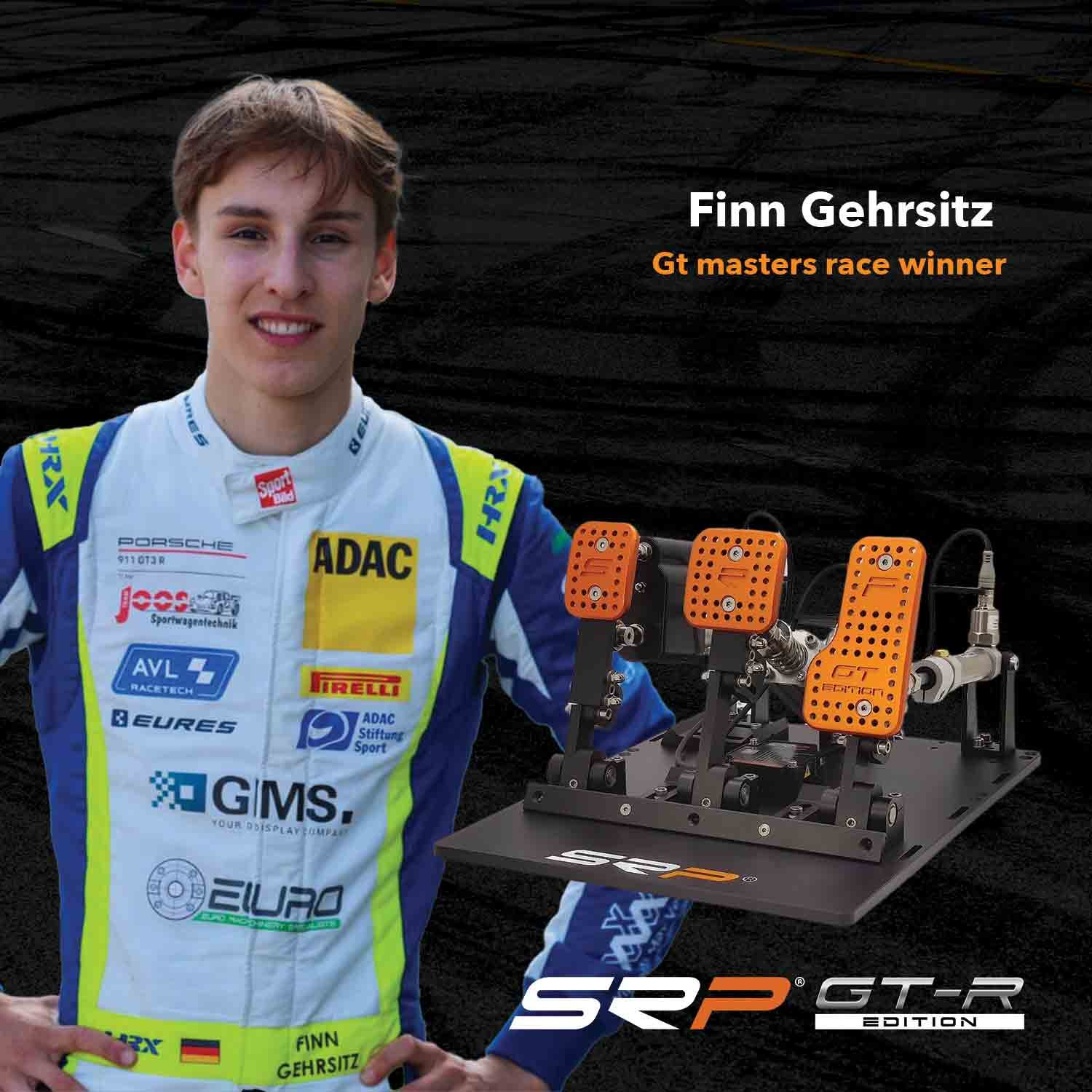
This is the engineering reason SRP® pedals are pneumatic: the opposing force your legs train against obeys a gas law instead of a wear schedule. Professional drivers preparing real races — Miguel Molina (2024 Le Mans overall winner), Daniel Juncadella (Daytona 24h & Spa 24h winner), Albert Costa (Le Mans class winner) — train on this hardware daily, and the haptic kit closes the loop entirely: ABS and traction-loss feedback delivered at the pedal, the moment the tires cross the limit. Full concept in Force Feedback in pedals: active vs passive.
Flagship · 3-Pedal Pneumatic
SRP® GT-R
Industrial-grade braking consistency for GT and endurance racing. The same force on lap 1 and lap 40 — your foot learns one brake point and keeps it forever.
View GT-R
2-Pedal Pneumatic Edition
SRP® GT-S
Aerospace-grade AL6061-T6 aluminum, 16-bit resolution, zero thermal fade. True pneumatic linearity for drivers who brake with pressure, not travel.
View GT-S
The Closest Thing To Pedal FFB
SRP® Haptic Kit
Adds ABS and traction-control feedback directly to your pedals — feel the exact moment the tires pass the limit through your feet. Compatible with GT-R, GT-S and Formula-R.
View Haptic Kit
/// Data, Not Immersion
Why FFB Wins (And Saves) Lap Time
FFB is not immersion — it is data. Through the wheel you feel the exact moment the front tires start to slide (understeer), when the rear steps out under throttle (oversteer), and how much grip is left in the contact patch before you ever see it on screen. Drivers who learn to read that language brake later, catch slides earlier, and stay consistent over a full stint.
In endurance racing — the discipline where professional teams validate our hardware — consistency over hours is worth more than a single heroic lap. As we explore in our racing telemetry guides, consistency relies on a flawless understanding of vehicle dynamics and hardware that translates your intent without degradation.
And once your hands are calibrated, close the loop: a mathematically correct FOV setting aligns what you see with what you feel — vision, hands and feet reading the same car at the same time.
/// Paddock FAQ
Force Feedback Questions
Cosa significa " FFB "?
FFB è l'acronimo di Force Feedback, ovvero le forze che un simulatore trasmette ai comandi per riprodurre il comportamento dell'auto virtuale: aderenza, trasferimento di peso, cordoli e urti.
Che cos’è il force feedback su un volante?
Un motore situato all’interno del passo trasmette la coppia all’albero, ricreando la consistenza del manto stradale, gli urti contro i cordoli, il sottosterzo e le collisioni. Le ruote azionate da ingranaggi e cinghie filtrano parte di questi dettagli; le basi “ Direct Drive ” li trasmettono tutti senza alcuna latenza.
I pedali sono dotati di force feedback?
Passive pedals don't — but brake feel is just as decisive. Load-cell and pneumatic pedals deliver pressure-based braking with zero fade, and add-ons like the SRP Haptic Kit bring ABS and traction-control feedback straight to your feet.
L'FFB e è importante per il tempo sul giro?
Sì. FFB ti spiega che gli pneumatici hanno raggiunto il limite prima ancora che te ne accorga. I piloti che imparano a interpretare l’angolo di slittamento e il trasferimento di peso frenano più tardi e riescono a correggere le sbandate prima.
Qual è la differenza tra la trasmissione a cinghia e quella a " Direct Drive "FFB?
I sistemi a cinghia attenuano (e perdono) i dettagli più fini a causa della cinghia e delle pulegge; Direct Drive monta il motore direttamente sull’albero per garantire un feedback a latenza zero e ricco di dettagli. Consulta la nostra guida “Direct Drive ” (DD) per un’analisi completa.
Una maggiore potenza dell'FFB e garantisce un feedback migliore?
No — clipping kills detail. When the signal exceeds what the motor can output, the peaks are cut off and the information is lost. A properly calibrated mid-strength signal beats a maxed-out one. Try the Signal Lab above to see it live.