
The Ultimate Guide to Race Simulator Pedals: Why Pneumatics are the Future
If you have ever lost crucial tenths of a second in the final sector of an endurance race because your brake pedal "felt different" than it did on lap one, you are experiencing the biggest flaw in modern sim racing hardware. The issue does not lie in your technique; it lies in the materials beneath your feet.
For years, the industry standard has relied on a combination of load cells, rubber elastomers, and sim racing springs. But as virtual motorsport demands professional-grade precision, standard static rubber compression is no longer enough. In this deep dive, we explore why elite drivers are abandoning traditional load cells and upgrading to the absolute consistency of race simulator pedals driven by dynamic pneumatic systems.
The Physics of Braking: Load Cells vs. Dynamic Pneumatics
To understand the leap in technology, we must analyze how braking forces are translated into telemetry. Traditional load cells measure pressure rather than travel distance, which was a massive step up from potentiometers. However, to simulate the physical travel of a real GT3 or Formula car pedal, standard systems use polyurethane elastomers.
This creates a critical point of failure: Thermal Fatigue.
The Elastomer Degradation Problem
When you apply 80kg to 100kg of force repeatedly over a 4-hour stint, the friction within the rubber elastomers generates heat. As the temperature of the polyurethane rises, the material softens. The resistance curve you memorized on lap 1 is completely different by lap 50. This thermal degradation forces you to continuously recalibrate your muscle memory, destroying your consistency during the crucial trail braking phase.
The Pneumatic Advantage: Zero Thermal Fatigue
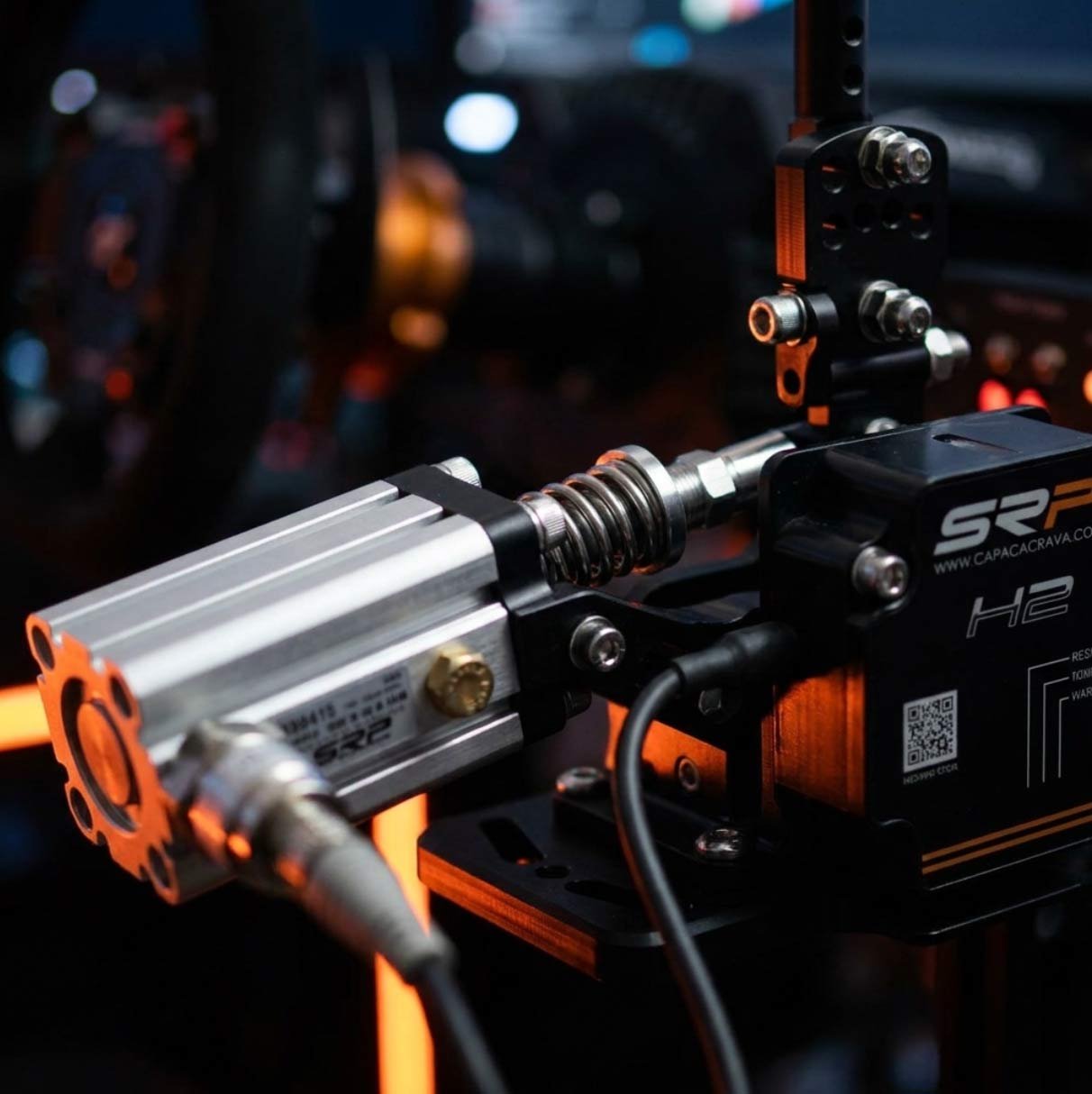
At SRP® SimRacing Pro, we engineered a solution that entirely bypasses rubber compression. The SRP® R-Piston Dynamic Pneumatic System relies on the physics of compressed air. When you press the brake, an industrial NBR seal compresses air within a hermetically sealed cylinder.
Air does not suffer from thermal fatigue. The mathematical formula for compressing that specific volume of air remains identical regardless of ambient temperature or race duration. The resistance is purely organic—building exponentially exactly like a real-world hydraulic braking system. When physics becomes instinct, your lap times drop.
Industrial-Grade Engineering: Beyond Standard Sim Racing Hardware
True high-end sim racing hardware is defined by its structural integrity. Flex is the enemy of precision. While mass-market pedals use laser-cut stamped steel or low-density aluminum alloys to cut costs, professional gear requires zero compromises.
Our pedal sets are 100% 5-axis CNC machined from Aerospace Aluminum AL6061. We do not use standard powder coating; every structural component undergoes a 28-micron hard anodized surface treatment. Combined with authentic SKF® Bearings, this guarantees zero mechanical friction and zero lateral play, allowing our 16-bit ceramic diaphragm transducers to read up to 65,536 steps of resolution with flawless accuracy.
| Hardware Specification | Traditional Load Cell Pedals | SRP® Pneumatic Systems |
|---|---|---|
| Resistance Medium | Polyurethane / Sim Racing Springs | R-Piston Dynamic Compressed Air |
| Consistency (Long Stints) | Variable (Suffers Thermal Fatigue) | Absolute (Zero Thermal Degradation) |
| Material & Finish | Stamped Steel / Powder Coat | AL6061 Billet CNC / 28-Micron Anodized |
| Mechanical Pivot | Standard Bushings (Prone to wear) | SKF® Industrial Bearings |
THE UPGRADE: Feel The Reality
Stop fighting your equipment. Upgrade to organic modulation, flawless trail braking, and industrial-grade durability. It is time to experience the pneumatic advantage.