
The Anatomy of SIFO: Why "Slow In, Fast Out" Dictates Pace
The Core Concept
It is the golden rule of motorsport. It dictates that sacrificing a fraction of a second on corner entry (by braking earlier and slightly more conservatively) allows you to rotate the car perfectly at the apex. This enables you to get on the throttle much earlier, carrying exponentially more speed down the following straight.
/// TELEMETRY: SIFO EXECUTION DYNAMICS
Understanding the Penalty of Over-Driving
The Anatomy of Understeer on Corner Entry
In the professional world of SimRacing, the difference between a podium and a DNF is hidden in technical nuances like SIFO entry speed. The most common mistake novice drivers make is "divebombing" their own line—braking too late in an attempt to gain time. While you might gain 0.1 seconds on the entry, braking too late overloads the front tires. The car understeers past the apex, forcing you to delay your throttle application. You ultimately lose 0.4 seconds down the subsequent straight because you lacked exit momentum.
Hydraulic Sim Pedals vs. Pneumatic Precision
Mastering SIFO requires immense confidence in your brake pedal. You need to know exactly when the car will stop and how the brake pressure will release (trail braking) so you can hit the apex perfectly.
Historically, high-end hydraulic sim pedals were considered the gold standard for this, as they mimic the fluid dynamics of a real race car. However, hydraulic systems come with severe drawbacks for home simulators: they require messy fluid maintenance, they are prone to leaks, and the fluid viscosity changes as the room temperature shifts, altering the brake feel.
Community FAQ: Hardware Constraints
/// PNEUMATIC SUPREMACY: SRP® ENGINEERING
This is where the SRP® Engineering philosophy redefines the paddock standard. To master your entry speed and nail the SIFO technique consistently, we eliminated the blistering issues of elastomers and the messy maintenance of hydraulics.
Our proprietary pneumatic architecture creates a perfect pressure curve that is immune to heat. Inside our AI6061-T6 aluminum monocoque chassis, 16-bit industrial transducers capture 65,536 steps of telemetry. No dead zones, no fluid leaks, no mechanical flex—just pure, repeatable data. Whether you are performing a heel-and-toe downshift or optimizing your threshold braking, SRP provides the linearity required to conquer every split and improve your iRating.
Hardware Built for Perfect Exits

SRP® GT-R Serie
The Endurance Master. Built to survive 24h stints with zero thermal degradation. Say goodbye to leaking hydraulic sim pedals and upgrade to ultimate pneumatic precision.
Upgrade to GT-R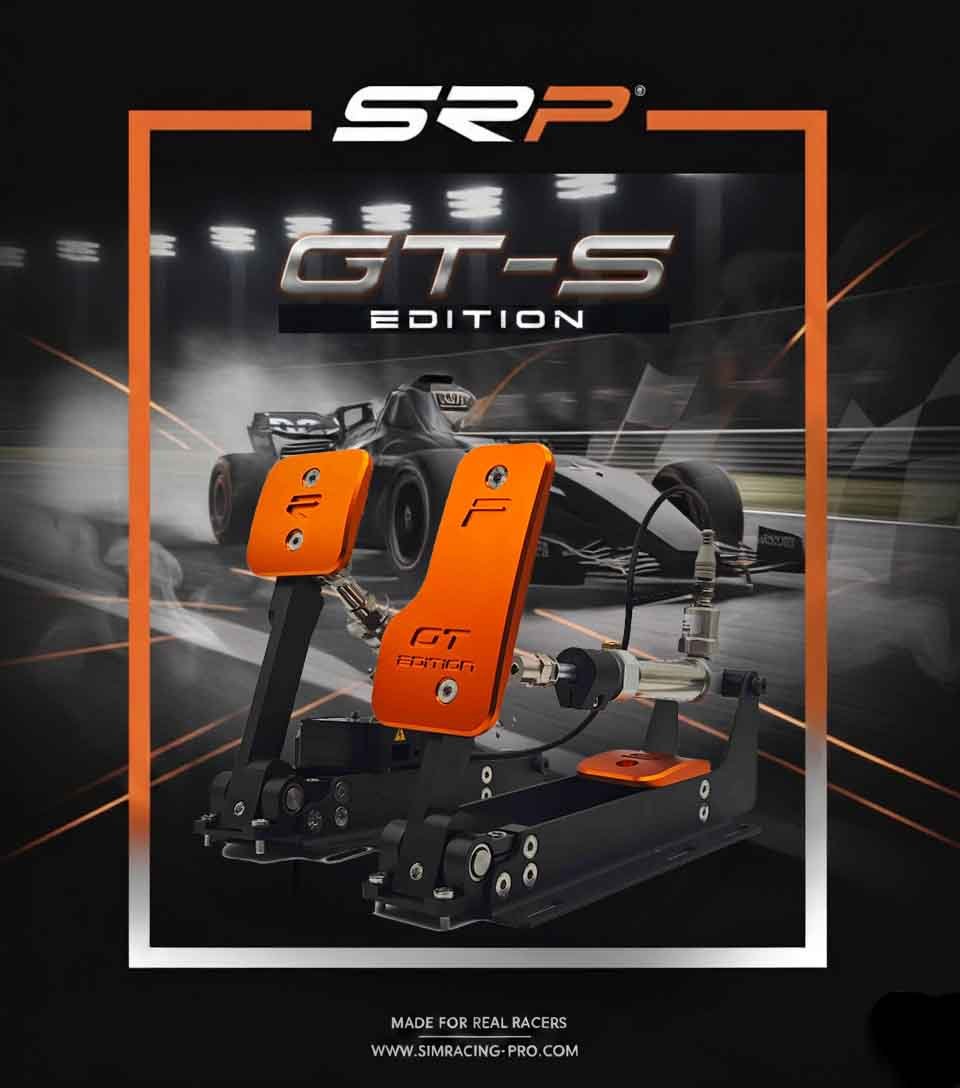
SRP® GT-S Edizione
Surgical precision for GT3 and Rally. Master your SIFO entry speed and dominate the apex with a flawless, frictionless pneumatic cylinder.
Discover GT-S