
Recorte inferior y recorte superior
The overtakes that happen in the pit lane instead of on the track. How both strategies actually work, what the Formula 1 record shows about when each one wins — and a strategy lab to run the exact pit-wall math yourself.
Definición
Por qué el pit lane es un campo de batalla
A pit stop costs roughly 20–25 seconds of track time — the time lost traversing the pit lane at the speed limit plus the stationary tire change. Crucially, that loss is identical for both cars: it cancels out of the strategic equation. What does not cancel is tire pace. Fresh rubber can be one to two seconds per lap faster than worn rubber, and that delta belongs entirely to whoever pits first.
The undercut weaponizes that gap: stop one lap before your rival, deliver two or three qualifying-grade laps on new tires, and when they emerge from their own stop they find you ahead. No wheel-to-wheel combat required. The strategy is so powerful that teams fake it constantly — sending a mechanic rolling toward the pit entry forces the rival to react, and sometimes the bluff alone wins track position.
What the Record Shows
These strategies are not theory. The modern F1 record contains textbook examples of both — including cases where the undercut worked even when the driver doing it did not want it to:
«Undercut» frente a «Overcut»: cuándo triunfa cada uno
| Corte inferior (empezando por el foso) | Sobrecorte (mantener la distancia) | |
|---|---|---|
| Funciona mejor cuando | El desgaste de los neumáticos es elevado; el caucho nuevo se desgasta mucho más rápido | New tires take long to warm up, degradation is low, or the rival rejoins in traffic |
| Requisito fundamental | Clean air for your out lap — traffic kills it (see Imola 2024) | You can still lap fast on worn tires without destroying them |
| El mayor riesgo | Rejoining behind a slow car and losing the tire delta clearing it | The rival's undercut gains more than your extra laps recover |
| The equalizer | A slow stop. At Monza 2025, a front-left problem left Norris stationary for over five seconds and inverted the order on its own — the pit crew is part of the strategy. | |
| Típico de | High-deg tracks, sprint formats, street circuits with long tire warm-up | Low-deg tracks, cold conditions, Monaco-style tracks with no overtaking |
Interactive Lab — Run the Pit-Wall Math
Calculadora de recorte inferior / recorte superior
The same model race engineers run on the pit wall. Set the gap, the fresh-tire advantage, the laps between stops and the warm-up penalty — the chart plots how the cumulative swing develops lap by lap, and the readout tells you if the move lands. (Assumes equal ~22 s stops for both cars, so stop time cancels; what remains is pure tire math.)
Estrategia en « Sim Racing »: tu papel en la historia
In iRacing endurance events and ACC races with pit windows, the undercut and overcut decide positions exactly as they do in F1 — except the sim gives you the engineer's job. The calculator above is the whole science: measure the fresh-versus-worn delta on your own stint, count the laps to the rival's stop, commit early. Most sim racers never do this math; the ones who do gain positions without ever getting close enough to draft.
But notice what the math quietly demands from the driver: the out lap and the in lap must be delivered at the limit, and the entire stint must be consistent enough for the delta to be real. A strategy calculated on paper is executed through identical inputs, lap after lap, for one or two hours. That is where hardware stops being a detail.
Every model above assumes your lap times are repeatable. A brake pedal whose feel drifts with temperature quietly corrupts the data your strategy was calculated on: the release point moves, braking zones stretch a car length, and the two fast out laps the undercut depends on never arrive. It is the same thermal fade that affects real race rubber — just hidden in your hardware instead of your tires.
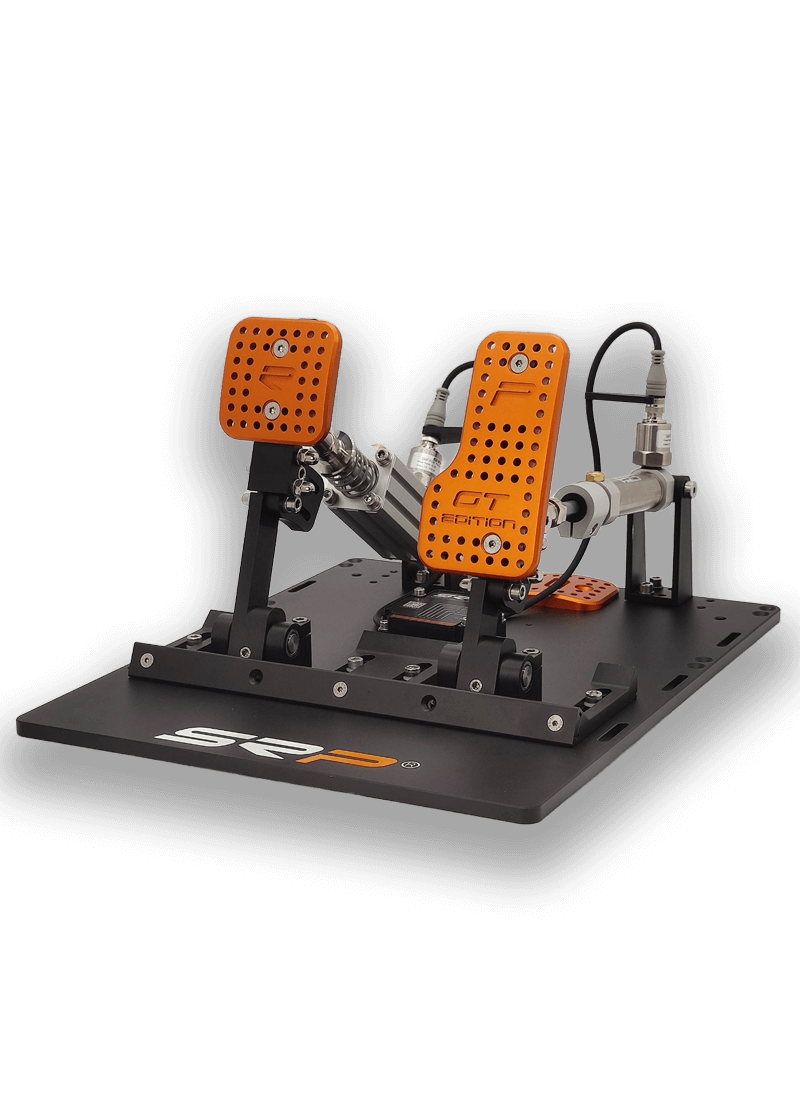
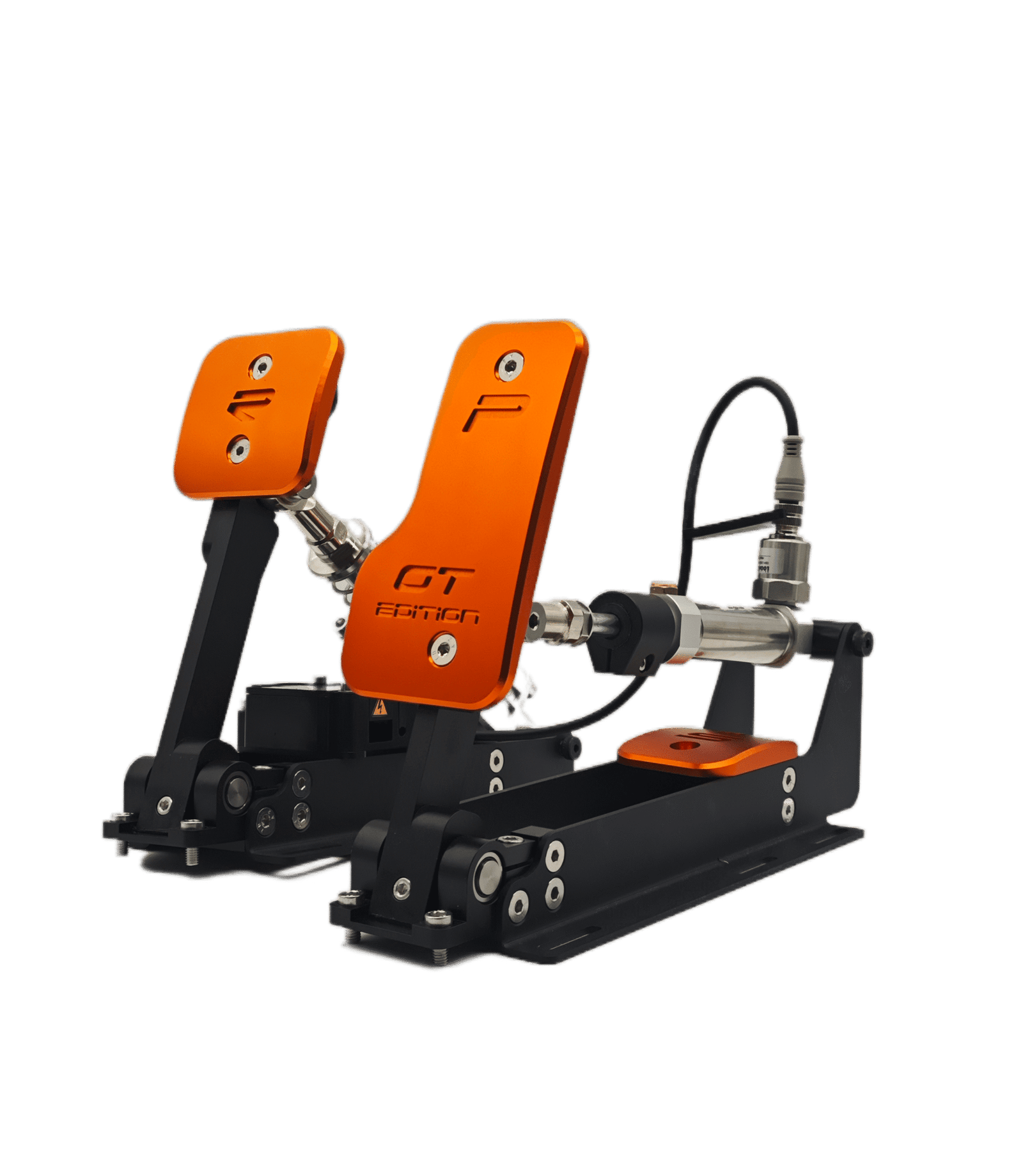
It is exactly why professional drivers preparing real races — Miguel Molina (2024 Le Mans overall winner), Daniel Juncadella (Daytona 24h & Spa 24h winner), Albert Costa (Le Mans class winner) — train on pressure-based pneumatic pedals such as the SRP® GT-R and GT-S: compressed air does not fatigue with heat, so lap 100 stops exactly where lap 1 did, sampled at 65,536 pressure steps. In endurance racing, the stopwatch cannot tell the difference between tire strategy and hardware consistency. Your rivals can.
Preguntas frecuentes
¿Qué es un «undercut» en la F1 y en las carreras?
A pit strategy where you stop earlier than the car ahead and use the pace advantage of fresh tires to gain enough time that, when they make their own stop, they rejoin behind you. It overtakes without wheel-to-wheel combat — Verstappen did exactly this to Hamilton at the 2021 French Grand Prix.
¿Qué es un sobrecorte?
The reverse strategy: stay out longer after the rival pits. You exploit their cold-tire warm-up laps or the traffic they rejoin into, build the gap on worn but predictable tires, and keep the position when you finally stop. Pérez's run to P4 at Monaco 2021 — without passing anyone on track — is the classic example.
¿Por qué el «undercut» es tan eficaz?
Because fresh tires can be 1–2 seconds per lap faster than worn ones, while a pit stop costs both cars the same fixed ~20–25 seconds. Two or three fast laps on new rubber routinely overturn a gap of several seconds. Hungary 2024 showed it even works unintentionally: Norris's three-lap tire advantage jumped him ahead of his own team-mate.
¿En qué casos funciona mejor el overcut?
When new tires take a long time to reach temperature (cold track, hard compounds), when degradation is low, or when the rival will rejoin into traffic while you have clean air. Monaco is the archetype: Pérez ran to lap 35 in 2021 and jumped three cars.
What kills an undercut?
Traffic. At Imola 2024, Norris undercut Verstappen but rejoined behind Pérez and spent his fresh-tire advantage clearing him — the winning margin was just 0.725 s. A slow stop can do the same: Norris's five-second front-left delay at Monza 2025 inverted the order on its own.
¿Funcionan los «undercuts» en « sim racing »?
Yes — anywhere there are pit stops and tire wear: iRacing endurance, ACC, F1 games. Measure your own fresh-versus-worn delta, apply the same pit-wall math, and commit to the stop one or two laps before the rival expects it. Most fields never run the numbers.
¿Cómo calculan los ingenieros el socavado?
Exactly like our calculator: fresh-tire advantage per lap multiplied by the laps between stops, plus the rival's warm-up loss, minus the current gap — assuming equal pit-stop times. If the result is positive, the undercut lands, provided the out lap runs in clean air.
Sources & further reading
- AUTOhebdo F1 — Undercut, overcut: everything you need to know about F1 strategies (France 2021, Monaco 2021 analysis)
- Sky Sports F1 — Hungarian GP 2024: Norris–Piastri pit-stop controversy timeline
- ESPN — Inside McLaren's history of team orders and close calls (Hungary 2024, Monza 2025)
- Formula1.com — 2024 Emilia-Romagna GP race report (Norris undercut vs traffic, 0.725 s margin)
- Autosport — Was McLaren's Italy 2025 comparison to Hungary 2024 accurate?
- GTPlanet — Pit delta times for all tracks (sim racing pit-lane loss data)
Sigue aprendiendo: La línea de vértice y la línea de carrera · El rebufo y la estela · La sincronización de revoluciones y la telemetría · La retroalimentación de fuerza (FFB) · Centro de ayuda de SRP®