
Drafting (Slipstream)
The oldest overtaking weapon in racing: hide in the wake of the car ahead, let it spend the air, and strike with free speed. The physics of the tow, the dirty-air paradox the data exposes — and a simulator to feel both.
Definition
The Physics: Why the Tow Is Free Speed
Aerodynamic drag grows with the square of speed. Past roughly 200 km/h, the majority of everything an engine produces is spent simply parting the air — which is precisely why the tow exists. A car ahead carves a low-pressure tunnel through the atmosphere; drive into it and your car suddenly has power to spare. On a long straight, a good tow is worth 10–20 km/h of top speed in GT and formula machinery alike.
That is why you see trains of cars at Monza, Daytona or Indianapolis: everyone wants the tow, nobody wants to lead. The lead car spends its own air; the cars behind bank theirs. NASCAR superspeedway racing takes it furthest — at Daytona and Talladega the draft is so strong that, with restrictor plates cutting roughly 300 hp from every engine, the pack runs inches apart at ~190 mph and the fastest car is simply the one with the most help behind it.
The Dirty Air Paradox: What the Data Shows
Here is the contradiction at the heart of the slipstream: the same wake that gifts you speed on the straight steals grip in the corners. Downforce is generated by clean air; inside the wake, front wings stall in patches and floors lose pressure. The FIA has measured exactly how much — and the numbers explain a decade of Formula 1 regulation changes:
The professional takeaway is gap management: close up in the braking zones and straights to harvest the tow, back off a few tenths through fast corners to let the front wing breathe again, then attack where the wake helps and the dirty air cannot hurt you. Modern sims model both halves of this — in ACC and iRacing you genuinely feel the car go light behind another car through fast bends, then get towed back on the straight.
| On the straight (the tow) | In the corners (dirty air) | |
|---|---|---|
| What happens | Drag drops; you accelerate harder and gain top speed | Downforce collapses; the car understeers and slides |
| Physical cause | Low-pressure hole punched by the lead car | Turbulent, disrupted airflow over your wings and floor |
| Best gap | 1–2 car lengths, in line behind the lead car | As far back as the next braking zone allows |
| Costs you | Nothing — it is free speed | Tenths per lap, plus extra tire degradation from sliding |
Interactive Lab — How Much Is the Tow Worth?
The Slipstream Simulator
Two cars flat out at 250 km/h. Drag the gap slider: the closer you sit in the wake, the more drag disappears — and the more speed you carry to the braking zone. Get too close, though, and remember the paradox above: this same air will steal your grip in the next corner.
/// Speed trace
Using It — and Finishing the Move
The classic mistake is pulling out of the slipstream too early: you leave the tow before you have converted it into a speed delta, and simply drive alongside at equal pace. The professional move is to stay in the wake as long as possible, pull out late, and arrive at the braking zone with momentum. Defenders answer by breaking the tow early or forcing you to the dirty side of the track — which is why the attack usually has one shot per straight.
And this is where the overtake is actually decided. The tow puts you alongside; the braking zone finishes the job — from roughly 250 down to 80 km/h, at the limit of the tires, often with the car not yet fully straight. Hitting your exact pressure point there, lap after lap, with zero hesitation, is what separates a repeatable braking system from a rubber block that changes feel as it heats. The late apex onto the straight (see our apex guide) is the other half of the loop: it is what keeps you close enough to take the tow in the first place.
An overtaking move is two transactions: the tow buys you position on the straight, and the braking zone converts it. The second one happens at the least forgiving moment of the lap — car slightly sideways, tires at peak temperature, everything happening in under two seconds. In that window there is no time to adapt to a pedal that feels different from the lap before: rubber elastomers soften with heat across a stint, so the pressure your foot memorized on lap 1 is not the pressure the pedal delivers on lap 30.
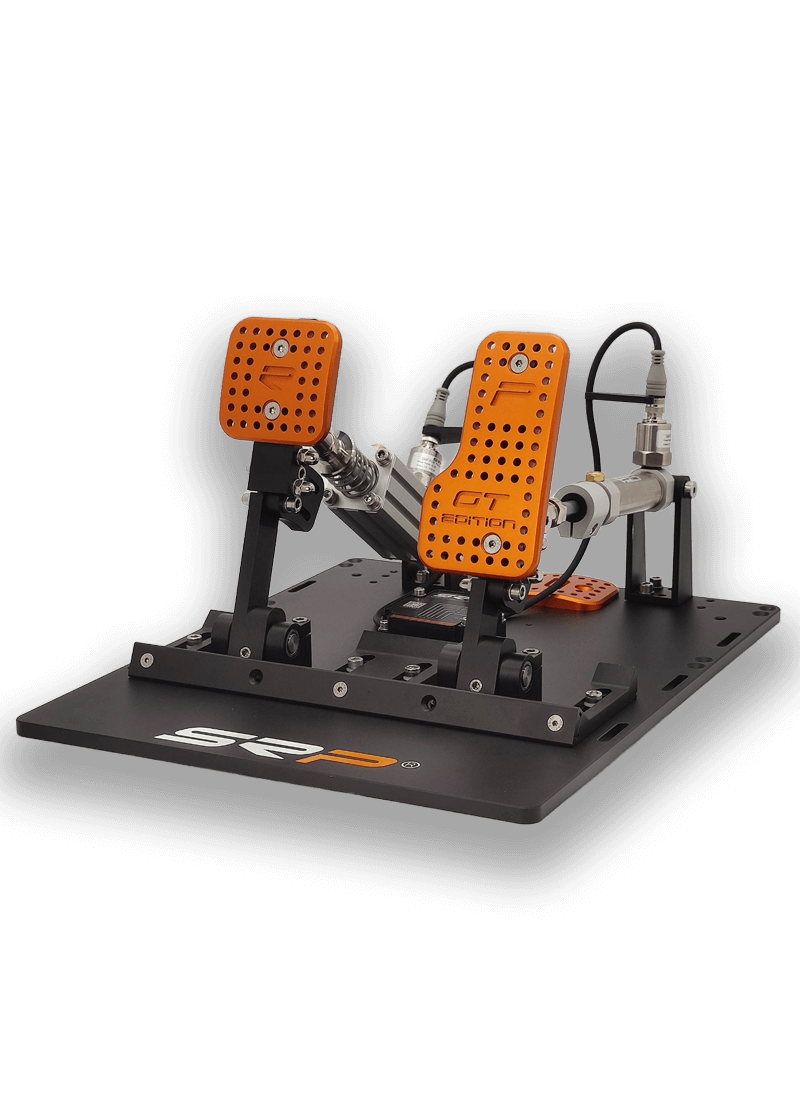
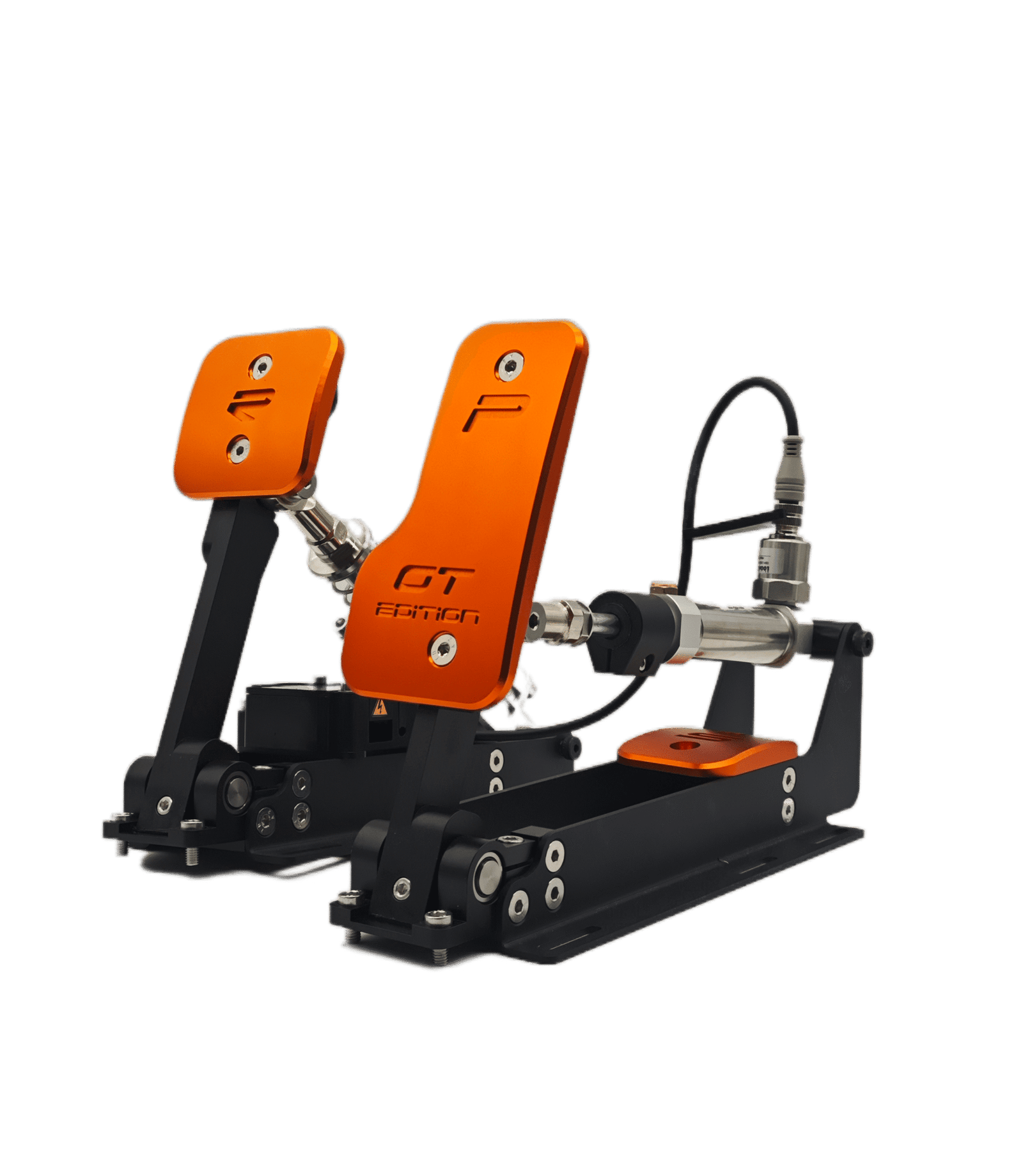
It is exactly why professional drivers preparing real races — Miguel Molina (2024 Le Mans overall winner), Daniel Juncadella (Daytona 24h & Spa 24h winner), Albert Costa (Le Mans class winner) — train on pressure-based pneumatic pedals such as the SRP® GT-R and GT-S: air compression does not fatigue with temperature, the release curve of lap 100 is the release curve of lap 1, and every braking zone in an overtake works exactly like the one you practiced. The tow is physics doing you a favor. The braking zone is where you have to return it.
Frequently Asked Questions
What is drafting in racing?
Drafting is following another car closely so it displaces the air for you: your car meets less drag, accelerates harder and reaches a higher top speed, setting up an overtake at the end of the straight.
What is a slipstream?
The slipstream is the low-pressure wake a fast car leaves behind it. A following car inside that wake needs far less power to maintain speed — it is effectively being towed by physics.
How much speed does drafting add?
Typically 10–20 km/h of top speed on a long straight in GT and formula cars — and at tracks like Monza, Daytona or Indianapolis it shapes entire sessions: a Monza tow is worth 0.3–0.5 s per lap, enough that in 2019 eight of ten Q3 cars timed themselves out waiting for one.
What is dirty air?
The same turbulent wake, experienced in corners: FIA measurements put the downforce loss for an F1 car one car length behind at 47% under the 2021 rules and 18% under the 2022 rules — before teams development clawed it back toward ~35% by 2025. Drivers manage the gap: close on straights, back off through fast corners.
How does DRS relate to the slipstream?
DRS was the artificial version of the tow: open the rear-wing flap within one second of the car ahead and gain a further ~10–12 km/h by the end of the zone, per FIA estimates. It ran from 2011 to 2025 and was replaced in 2026 by active aerodynamics and an electrical Overtake Mode.
Does drafting work in sim racing?
Yes — iRacing, ACC and rFactor 2 all model slipstream and dirty air. The tow effect is slightly gentler than in reality but the technique is identical: sit in the wake, pull out late, finish the move under braking.
How do you defend against the slipstream?
Break the tow before it forms (small positioning changes on the straight, within the rules), take the defensive inside line early, and force the attacker to the dirty side of the braking zone where grip is lowest.
Sources & further reading
- Formula1.com — 10 things you need to know about the all-new 2022 F1 car (FIA dirty-air research: 35%/47% downforce loss, 4%/18% targets)
- The Race — Revealed: The data on F1's worsening dirty air problem (FIA CFD analysis, 2025)
- RaceFans — Why the FIA believes its 2026 rules will significantly improve F1's dirty air problem (Tombazis interview)
- Formula1.com — Pole-sitter Leclerc calls Monza qualifying a big mess as several drivers time out (2019)
- Wikipedia — Drag reduction system (1-second rule, FIA 10–12 km/h estimate, 2011–2025, 2026 replacement)
- Motorsport.com — Why Monza F1 qualifying has moved away from chaotic slipstream bonanza
- HowStuffWorks / NASCAR Hall of Fame — How NASCAR drafting works (restrictor plates, superspeedway pack racing)
Keep learning: The Apex & Racing Line · Force Feedback (FFB) · Direct Drive (DD) · Rev-Matching & Telemetry · SRP® Help Center