
The Pneumatic Pressure Curve
Brake feel is not a vibe — it is a mathematical curve. The polytropic law behind every pneumatic pedal, why the exponential shape is the secret of trail braking, and how to tune yours.
Definition
The Physics: It Is Just the Gas Law
Compress a gas and it pushes back harder the smaller you make it. That relationship is the polytropic process — the same law that governs turbocharger compression and diesel ignition — and for air it holds with remarkable fidelity inside a sealed cylinder:
Translate that to a pedal and the consequences are immediate. At the top of the stroke, large volume, small compression: the pedal is light and precise, and your foot works in millimeters. As travel increases, the shrinking volume pushes back disproportionately — the resistance builds exactly where a brake should fight hardest. No algorithm generates this curve; no firmware approximates it. It is the atmosphere doing arithmetic.
This is also why the curve stays identical lap after lap and year after year. A gas in a hermetic cylinder has no fatigue mechanism: nothing softens, nothing hardens, nothing wears. The curve of lap one is the curve of lap ten thousand — a claim no polymer stack can make by definition.
Interactive Lab — The Curve Explorer
Shape the Curve Yourself
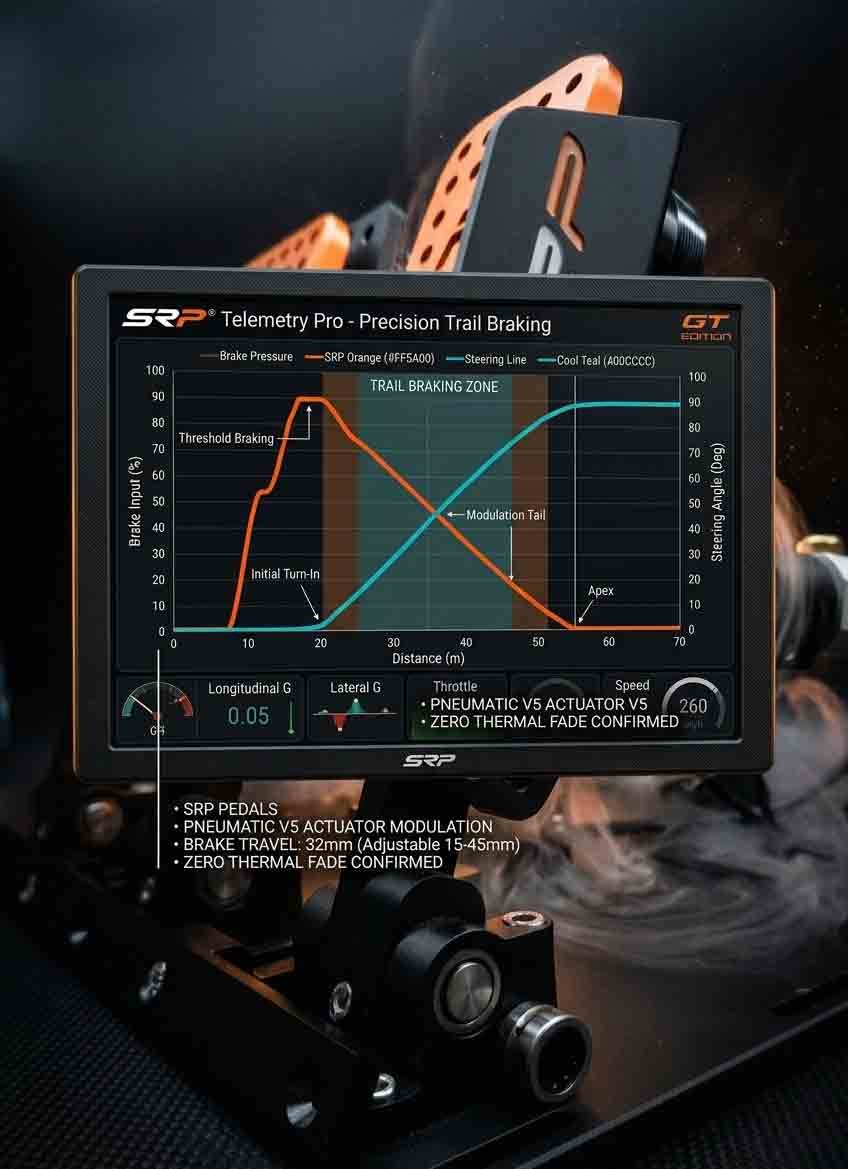
The SRP R-Piston V5 lets you regulate total travel between 15 and 45 mm — which reshapes the exponent your foot experiences. Drag the sliders: the shaded band is the 5–20% trail zone, and the number that matters is how many millimeters of physical travel fall inside it.
Why the Shape Decides Your Braking
Every braking technique you own is a negotiation with this curve. Trail braking happens in the soft first millimeters: on an exponential, that zone is wide in travel and forgiving in force — you can hold 10% and bleed it smoothly. Threshold braking happens at the steep end: resistance ramps hard, so your leg loads up exactly like a race car's pedal under 100+ bar of line pressure. A linear elastomer gives you neither: the top is too stiff for fine modulation (the "brick wall"), and the bottom gives no progressive warning before lock.
And because the pneumatic curve is physics rather than material, it does not change character with temperature, age or use. The 10% you memorized is the same 10% in January and July, on lap 1 and lap 500. That is what "the reference must not move" means in practice.
Interactive Lab — Find Your Setup
Which Travel Should You Run?
Short travel feels direct and racey; long travel widens every zone your foot has to work in. Answer three questions and get a starting point — then fine-tune with the explorer above.
Where SRP® Sits in This
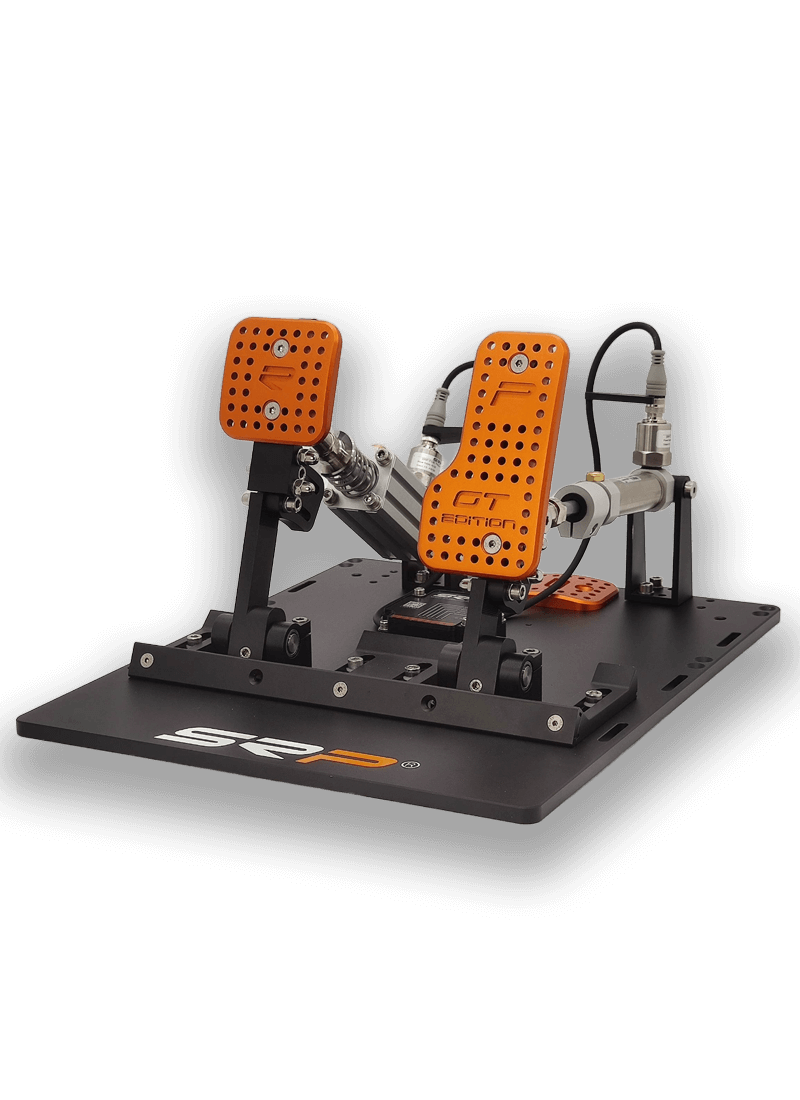
Everything in an SRP® brake exists to serve one curve: the polytropic compression of air inside the R-Piston V5's hermetic cylinder, sampled at 16-bit and shaped only by the laws of physics. The travel regulation — 15 to 45 mm — does not add gimmicks; it moves you along the same exponential, trading total stroke against force per millimeter until it matches your car, your feet and your style.
It is why professional drivers preparing real races — Miguel Molina (2024 Le Mans overall winner), Daniel Juncadella (Daytona 24h & Spa 24h winner), Albert Costa (Le Mans class winner) — train on these pedals: a curve that obeys a law instead of aging like a material is the closest thing sim racing has to a permanent reference. Your muscle memory deserves an invariant.
Frequently Asked Questions
What is a pneumatic pressure curve?
The relationship between pedal travel and brake pressure in an air-based pedal: an exponential curve produced by compressing a sealed gas volume, described by the polytropic law P·V^γ = const with γ ≈ 1.4 for air. Light at the top of the stroke, progressively firmer as travel increases.
Why is an exponential curve better than a linear one?
Because braking techniques live at both ends of the curve. Trail braking needs fine control at 5–15% pressure — the soft, spacious top of an exponential. Threshold braking needs rising resistance toward full force — the steep end. A linear elastomer is equally stiff everywhere, which starves the trail zone and saturates the top: the classic "brick wall" complaint.
Does the pneumatic curve change with temperature?
Within any plausible sim-racing temperature range, negligibly — and unlike elastomers or brake fluid, it has no aging mechanism. Air in a hermetic cylinder does not fatigue, absorb moisture or degrade. The curve is a physical law, not a material property.
What does adjusting pedal travel actually change?
Total travel (15–45 mm on the R-Piston V5) reshapes how the same exponential feels: shorter travel packs the full curve into fewer millimeters for a direct, high-force feel; longer travel spreads it out, widening the low-pressure trail zone. Same law, different scale.
Is a pneumatic curve like a real race car's brake?
In shape, yes — real race systems are progressive rather than linear, building from a soft initial take-up to very high line pressures (100–150 bar). Real cars add hydraulic damping and thermal effects that sims do not reproduce; the pneumatic curve keeps the progressive shape while removing the liquid and its maintenance.
How does the 16-bit resolution interact with the curve?
The physics shapes the curve; the sensor only samples it. 65,536 steps mean the sampling never quantizes the release — after typical calibration dead-zones, thousands of usable steps remain in the 5–20% trail band, far beyond anything a foot can distinguish step by step.
Where should I set my travel as a beginner?
Start mid-range (around 30 mm), then move shorter if you find yourself reaching too far for full pressure, or longer if your trail release feels twitchy. Change one thing at a time and give it two sessions — muscle memory recalibrates faster than you think when the curve itself never changes.
Sources & further reading
- Wikipedia — Polytropic process (P·Vⁿ = const, adiabatic exponent for air γ ≈ 1.4)
- Tilton Engineering — Brake system technical documentation (race line pressures, pedal force ratios)
- Driver61 — How to Trail Brake (the 5–15% trail pressure coaching standard)
- SRP® — Stiff vs Soft Sim Racing Pedals: Muscle Memory Guide (curve shaping and travel regulation)
- SimRacingTelemetry Docs — Analyzing Racing Lines in Telemetry Data (brake release vs maximum steering sequence)
Keep learning: How to Trail Brake · Pneumatic vs Hydraulic Pedals · SRP vs Best Load Cell Pedals · The Apex & Racing Line · SRP® Help Center