
Pneumatic vs Hydraulic Pedals
The two premium braking technologies for sim racing, compared on physics and data — not marketing. What DOT 4 fluid actually does over time, what compressed air does not, and where each system genuinely wins.
Definition
Hydraulic Pedals: Real Race Tech — and Real Race Maintenance
Hydraulic sim pedals are not a simulation of anything: they are the real system. Press the pedal and you displace fluid against a pressure transducer — exactly what happens in a GT3 or Formula car. The feel is unquestionably authentic: progressive, damped, alive. Vendor data also credits the technology with sub-millisecond response and very high pressure resolution — figures that are plausible precisely because liquids are incompressible.
But the liquid is also the liability. Race brake fluid is hygroscopic — it pulls water out of the air through seals and hoses for as long as it lives in the system. And water changes everything:
In a race car this maintenance is invisible — a mechanic does it between sessions. On a sim rig in your living room, you are the mechanic: bleeding the circuit, watching for weeping seals, keeping fluid away from carpet and electronics. None of this makes hydraulic pedals bad. It makes them a system you own, rather than a component you use.
Pneumatic Pedals: The Same Curve, Without the Liquid
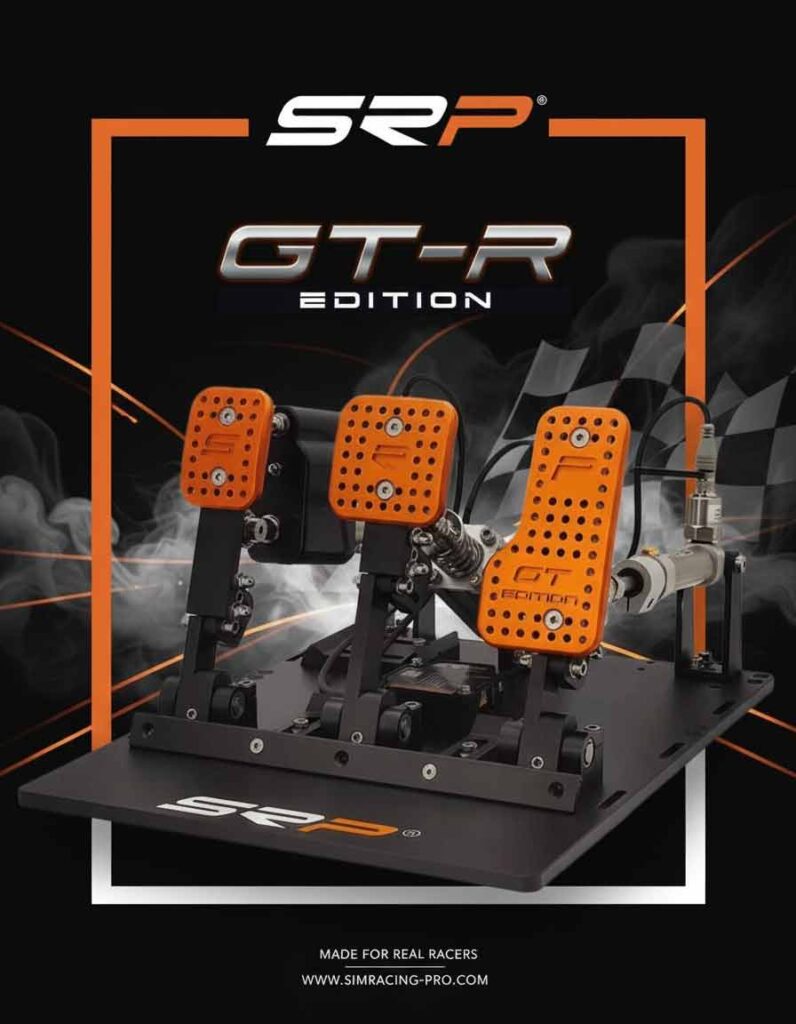
Pneumatic braking keeps the physics that matters and deletes the chemistry that doesn't. A sealed cylinder compresses air: the pressure curve is exponential and progressive, mechanically close to a master cylinder's — because race brake feel was never really about the fluid, it was about the pressure curve. Air compresses predictably, bleeds heat instantly, and — critically — does not absorb water, does not boil, does not degrade, and cannot leak onto your floor.
The trade-offs are honest ones. Air is compressible by design, so a pneumatic pedal is a tuned air spring rather than a liquid ram: brands tune the cylinder volume and valving to reproduce the master-cylinder curve, and the result is slightly different in texture — typically described as smoother and more linear at the top of the stroke. And because the whole system is hermetic and solid-state, the maintenance schedule is: none. The curve of year three is the curve of day one.
The Honest Verdict
| Hydraulic | Pneumatic | |
|---|---|---|
| Feel realism | The real-car reference: liquid damping, race-car texture | Master-cylinder-style progressive curve, slightly smoother top-end |
| Consistency over a stint | Excellent fresh; degrades with fluid age and heat | Constant — air does not fatigue, absorb water or boil |
| Maintenance | Bleed every 1–2 years (yearly for racing use), seal checks, leak risk near electronics | None. Hermetic cylinder, no fluid, no seals to weep |
| Failure modes | Vapor/spongy pedal, micro-leaks, fluid contamination | Largely limited to the transducer and electronics |
| Price band | Typically $600–1,500 + consumables | From 599 €, no consumables |
| Choose it if… | You want maximum realism and enjoy wrenching on your rig | You want the pressure curve with zero maintenance and year-3 consistency |
Interactive Lab — The Fade Lab
What Heat and Time Do to Brake Fluid
This is real DOT 4 physics: fluid absorbs roughly 3.7% water in two years, and its boiling point slides from 230°C toward 155°C as it does. Slide the fluid temperature and the fluid age, and watch what happens to the pressure curve — dead travel grows, peak pressure drops. The pneumatic trace does not move, because air has no chemistry to degrade.
Interactive Lab — The 3-Year Cost of Ownership
What Each System Really Costs
Sticker price is the start of the equation, not the end. Add fluid, seals and your own bleeding time on the hydraulic side, subtract resale on both — the chart plots cumulative cost month by month.
Where SRP® Sits in This
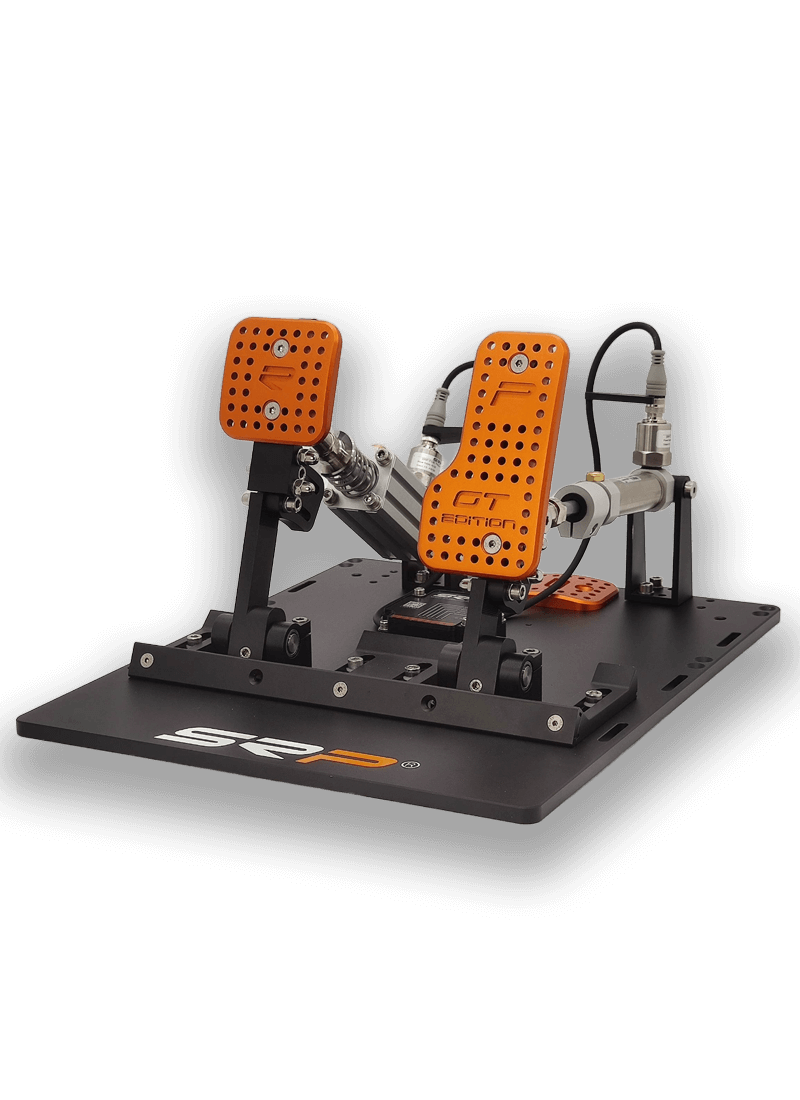
We build both sides of this comparison for a living, and we chose compressed air for the same reason the data above points to: the pressure curve is the product, and the fluid is a liability. The SRP® R-Piston V5 compresses air inside a hermetically sealed, aerospace-grade AI6061-T6 cylinder — no reservoir to top up, no seals weeping onto your carpet, no fluid chemistry to schedule your season around.
The consistency argument is not theoretical: professional drivers preparing real races — Miguel Molina (2024 Le Mans overall winner), Daniel Juncadella (Daytona 24h & Spa 24h winner), Albert Costa (Le Mans class winner) — train on these pedals daily. A race team bleeds its brakes every session; a sim racer should not have to. That is the entire thesis of pneumatic: the curve of a master cylinder, the maintenance of a brick.

Frequently Asked Questions
Are pneumatic pedals as realistic as hydraulic?
Different texture, same physics principle. Both produce a progressive pressure curve like a real master cylinder; hydraulic adds liquid damping that some drivers love and others describe as maintenance they didn't sign up for. Air is slightly smoother at the top of the stroke. Most drivers adapt within days — professional drivers training for real races use pneumatic daily.
Do hydraulic sim pedals need maintenance?
Yes. The fluid is hygroscopic: it absorbs roughly 3.7% water in about two years (racing guidance is yearly replacement), needs bleeding when air enters the circuit, and seals can weep with use. It is the same maintenance a real race car gets — except in a race car, a mechanic does it.
Can brake fluid actually boil in a sim pedal?
The physics is real: DOT 4 boils at 230°C dry but 155°C once saturated with 3.7% water, and vapor is compressible where liquid is not — the pedal goes spongy and long. A sim pedal never sees 155°C at the transducer, but age, heat and micro-bubbles produce the same sponginess at smaller scale, which is exactly why hydraulic systems get bled.
What breaks on a pneumatic pedal?
Very little: a sealed cylinder of air has no fluid chemistry and no wearing elastomer stack. The realistic failure points are the pressure transducer and electronics — the same components a hydraulic pedal also depends on for its signal.
Are hydraulic pedals faster?
Vendor data credits hydraulics with sub-millisecond response and high pressure resolution; pneumatic transducers are also sampled at 16-bit/65,536 steps with effectively instant physical response. In practice both are far below human perception thresholds — consistency lap after lap matters more than microseconds, and that is a maintenance question, not a speed one.
Which is better for a beginner?
If you want the most authentic possible feel and enjoy tinkering, hydraulic is the reference. If you want the pressure curve with zero maintenance and identical feel in year three, pneumatic. For most sim racers the honest answer is the one they will actually maintain.
Do pneumatic pedals leak air?
The SRP system is hermetically sealed at the factory; it does not consume air and does not need refills. Unlike hydraulic fluid, even a hypothetical seal issue with air means a softer pedal — not liquid on your floor and electronics.
Sources & further reading
- AutoZone DIY — DOT 3 vs DOT 4 Brake Fluid (dry/wet boiling points, absorption rates)
- AMSOIL Blog — DOT 3 and DOT 4 Brake Fluid: What's the Difference? (hygroscopy, yearly racing replacement)
- Tilton Engineering — Brake Fluid: Stay Safe And Go Fast (vapor lock physics)
- ADVICS Aftermarket — Brake Fluid Boiling Points (3.7% wet standard, saturation timeline)
- Epic Bleed Solutions — Wet and dry boiling points (Shell data: boiling point collapse at 8% water)
- SimRacingSetup — The Best Sim Racing Pedals 2026: Buyers Guide (technology tiers, $600–1,500 hydraulic band)
- Apex Sim Racing — Load Cell vs Hydraulic vs Active Pedals (maintenance trade-offs)
Keep learning: How to Trail Brake · Load Cell vs Pneumatic 2026 · The Pneumatic Pressure Curve · The Apex & Racing Line · SRP® Help Center