
How to Trail Brake in Sim Racing
The release phase, the weight transfer, and the data behind it — iRacing & ACC
Definition
The Physics: Why the Last 10% Matters
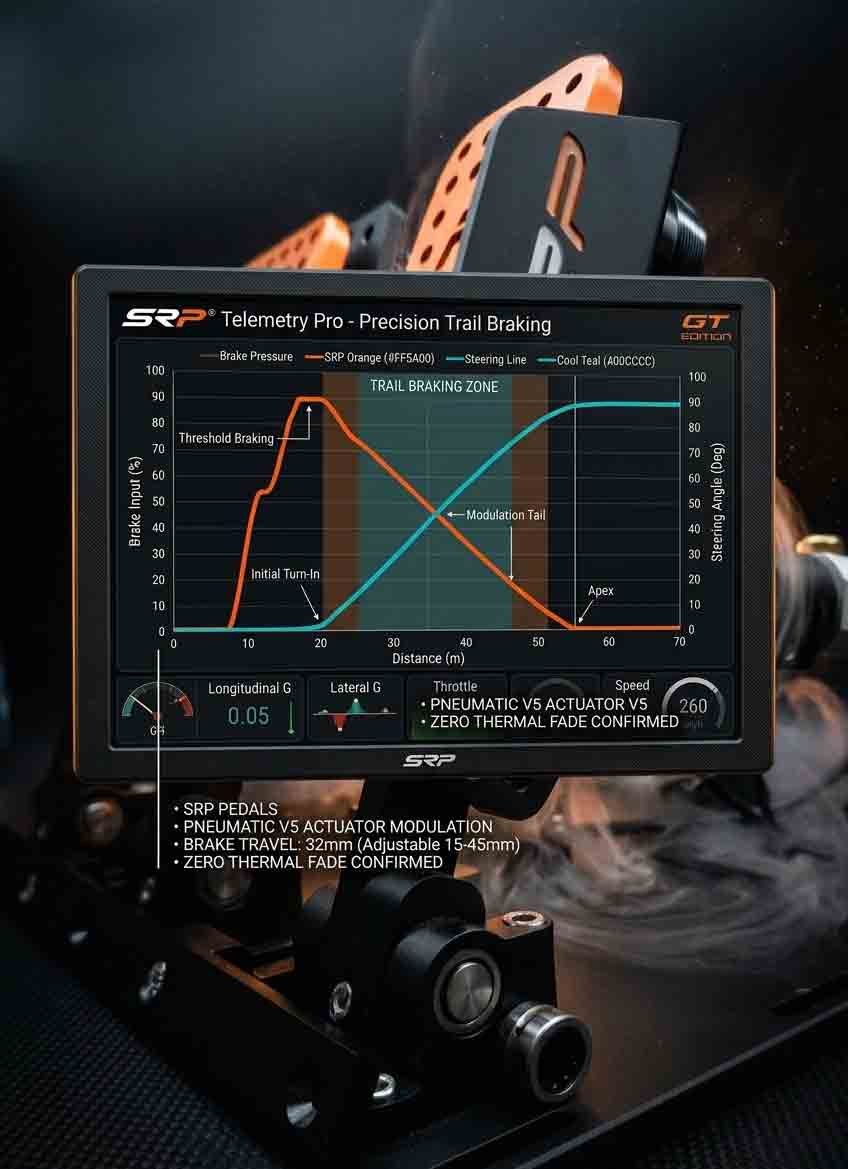
Braking transfers weight to the front axle; that load is what generates front tire grip. In a classic straight-line stop you use that grip purely to slow the car — but a corner asks the front tires to steer at the same time. Trail braking is the compromise that solves both: you keep a small amount of pressure (typically 5–15%) carried past turn-in, holding weight over the nose so the car rotates, then release the remainder smoothly as the steering reaches full lock.
Release too early and the front lifts, the tires lose their load, and you understeer wide on exit. Carry too much and you lock the fronts or snap the rear loose. The window between those two failures is narrow — and telemetry shows the fastest drivers live inside it, lap after lap.
Interactive Lab — The Trail Braking Simulator
Feel the Release
Two variables decide your trail braking: how much pressure you still hold at turn-in, and how long you take to bleed it off. Set both below and watch the traces — the blue ghost is the reference lap (10% trail, release finishing at the apex). Your orange trace shows the cost of getting it wrong. The chassis ball shows weight transfer live.
The Hardware Bottleneck: Why You Keep Locking Up
Trail braking demands surgical pressure resolution — the difference between 10% and 14% at the pedal is the difference between rotating and locking. This is where conventional load-cell pedals with rubber elastomers quietly fail you: rubber changes stiffness as it heats, so the pressure your foot memorized on lap 2 is not the pressure the pedal delivers on lap 20. You are not inconsistent — your reference keeps moving.
A trail-braking input is a memorized curve: pressure threshold on entry, a controlled bleed through turn-in, and the final release timed to the apex. If the pedal's pressure-versus-travel relationship drifts with temperature, every point of that curve shifts a little — and a little is all it takes to lock a front tire at 200 km/h. This is the thermal fade documented in comparative hardware tests between elastomer and pneumatic systems.
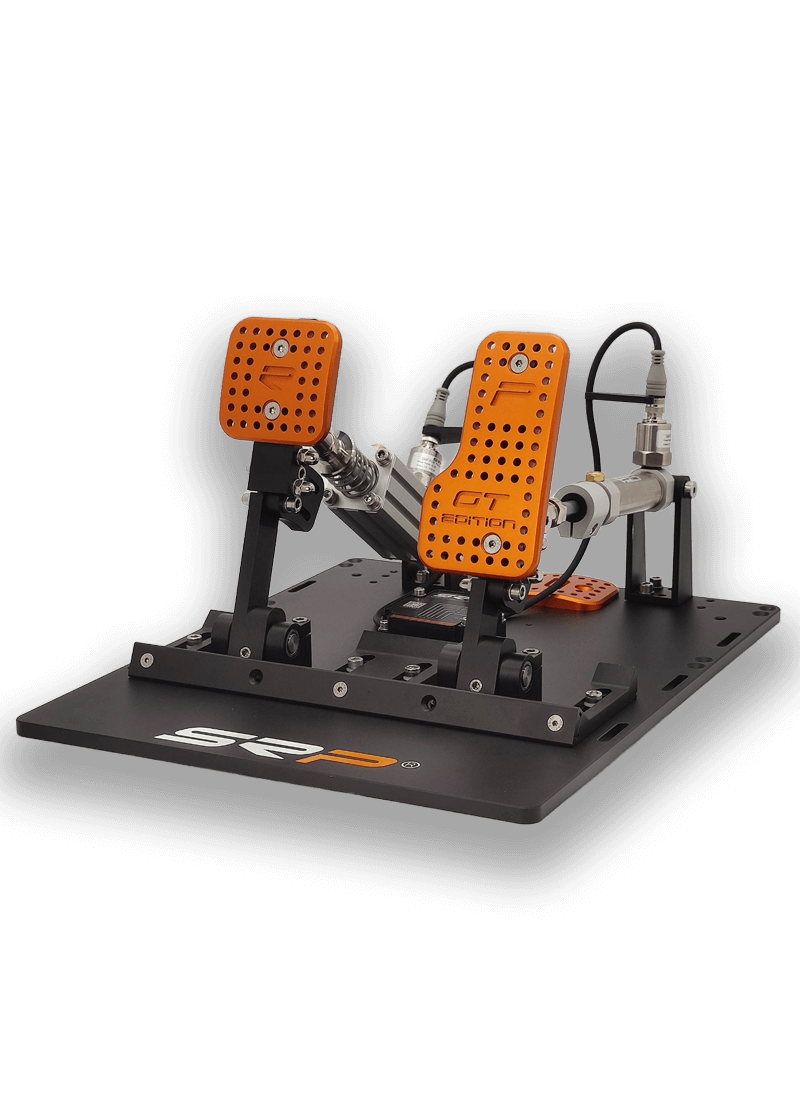
It is exactly why professional drivers preparing real races — Miguel Molina (2024 Le Mans overall winner), Daniel Juncadella (Daytona 24h & Spa 24h winner), Albert Costa (Le Mans class winner) — train on pressure-based pneumatic pedals such as the SRP® GT-R and GT-S: compressed air does not fatigue with heat, so the 10% trail pressure of lap 100 is the 10% of lap 1, sampled at 65,536 pressure steps. There is a second lever too: the R-Piston V5's travel regulation lets you set the brake stroke between 15 and 45 mm — a longer stroke physically widens the window in which your foot can modulate that final release.
Interactive Lab — Plan Your Pedal Travel
How Much Stroke Does Your Foot Need?
The trail phase happens in the last few millimeters of pedal travel. Set your R-Piston travel and see how much physical window your foot actually gets to modulate the release — and which problem each setting solves.
Stop blaming your hands when the reference keeps moving under your foot. With a pedal that feels identical every lap, trail braking stops being a guessing game and becomes a repeatable reflex — and the tenths you were missing reappear in the delta.

Frequently Asked Questions
What is trail braking?
The technique of carrying brake pressure into the turn-in and releasing it progressively while the steering builds, instead of finishing all braking in a straight line. The residual pressure keeps weight over the front tires so the car rotates, and the smooth release sets up the exit.
How much brake pressure should I carry into the corner?
Typically 5–15% of peak pressure past turn-in, bled to zero before maximum steering angle. The exact number depends on the car, tires and corner — the principle is universal: release smoothly, and finish releasing before you ask for full lock.
Why do I lock the front tires when trail braking?
Usually two causes: carrying too much pressure for the available front grip once steering is added, or a pedal whose feel changed since your reference lap — rubber elastomers soften with heat, so the same foot position produces more pressure than you expect. ABS feedback at the pedal helps you catch it early.
Is trail braking used in real racing?
It is standard technique in almost every circuit discipline. Published F1 telemetry traces show exactly the same shape sim drivers chase: one smooth pressure ramp from threshold down to trail, finishing before peak steering. The physics of weight transfer do not care whether the car is real or simulated.
Does trail braking work in iRacing and ACC?
Yes — both sims model weight transfer and tire load sensitively enough that trail braking is a genuine technique, not a trick. The fast traces show the same signature as real telemetry: brake fully released just before maximum steering, minimum speed at the apex.
What pedal travel is best for trail braking?
Longer travel (35–45 mm) widens the physical window for modulating the release and suits drivers struggling to hold steady low pressures; shorter travel (15–25 mm) suits quick direction changes and drivers with strong, precise ankle control. The SRP R-Piston V5 is adjustable between 15 and 45 mm so you can tune it per track and car.
How long does it take to learn trail braking?
The technique itself is learned in a few focused sessions — the limiting factor is reference consistency. With a pedal that does not change feel with temperature, muscle memory locks in within weeks instead of months, because every lap reinforces the same input curve.
Sources & further reading
- Driver61 — How to Trail Brake (racing-line and trail-braking tutorial, Mansell)
- Autosport Forum — Telemetry Analysis of Lewis Hamilton (Monaco braking traces)
- SimRacingTelemetry Docs — Analyzing Racing Lines in Telemetry Data (brake release vs maximum steering sequence)
- TrackTitan — How to Analyse Telemetry for Sim Racing (apex minimum-speed and exit-speed comparison)
- The Field F1 — F1 Telemetry Data & Charts Explained (throttle/brake trace interpretation)
- iRacing telemetry guides — trophi.ai / Braking Lab (braking zone and release smoothness metrics)
Keep learning: The Apex & Racing Line · Drafting & Slipstream · Undercut & Overcut · Force Feedback (FFB) · SRP® Help Center