
SRP Pedals vs The Best Load Cell Pedals
An honest, spec-sheet-level comparison. What a load cell actually measures, where its resistance really comes from, and what compressed air changes — with the counter-arguments included.
Definition
What the Best Load Cell Pedals Do Brilliantly
Let us be fair first, because the best load cell pedals are genuinely excellent hardware. Measuring force instead of position fixed the core problem of early sim racing: no more guessing brake input from pedal travel. Muscle memory became trainable. The reference sets everyone cites — the Heusinkveld Sprint line, the Fanatec CSL Load Cell kit — are well-built, well-supported, and have made thousands of drivers faster.
Experienced sim racers push back on the fade narrative: "elastomers heat up and change properties with temperature — but in practice the effect may be negligible" (r/simracing). They have a point, and this post will not pretend otherwise. Modern thermoset compounds are far more stable than early polyurethane. The honest distinction is this: the load cell sensor does not drift — but the elastomer stack that creates your brake feel is still a polymer, polymers age and heat-cycle, and manufacturers themselves replace compounds when they improve them. Whether that drift costs you tenths depends on your compound, your climate and your standards. The only stack with zero drift by definition is one with no polymer in it at all.
The Curve Lab: Where the Feel Actually Comes From
Force vs Travel, Drawn Honestly
Every brake pedal is a force-versus-travel curve. The shaded band is the zone that matters for trail braking — 5% to 20% of peak force, where the release is modulated. Select a profile and compare the physical millimeters your foot gets inside that band. The pneumatic curve is drawn in orange for reference in every mode.
The Bit Lab: Does Resolution Matter?
12-Bit vs 16-Bit, On a Log Scale
Electronics specs get thrown around as marketing weapons. Here is the honest picture: select a bit depth and see the raw step count — and how many of those steps survive inside the 5–20% trail band after typical calibration.
The Honest Verdict
| Best load cell pedals | SRP pneumatic | |
|---|---|---|
| Sensing | Force via strain gauge — excellent | Force via pressure transducer — equivalent class |
| Resistance | Rubber elastomer stack (polymer, wear-tested, replaceable) | Sealed compressed air — no polymer in the load path |
| Trail window | ~0.5–1.0 mm depending on stack | ~1.5–1.7 mm, constant with temperature |
| Maintenance | Occasional stack replacement; feel varies with compound age | None — hermetic cylinder |
| Electronics | 12-bit typical (4,096 steps) | 16-bit (65,536 steps) |
| Choose it if… | You already own them and they serve you — they are good pedals | You want the curve of air: maximum modulation window, zero stack drift, nothing to replace |
Where SRP® Sits in This
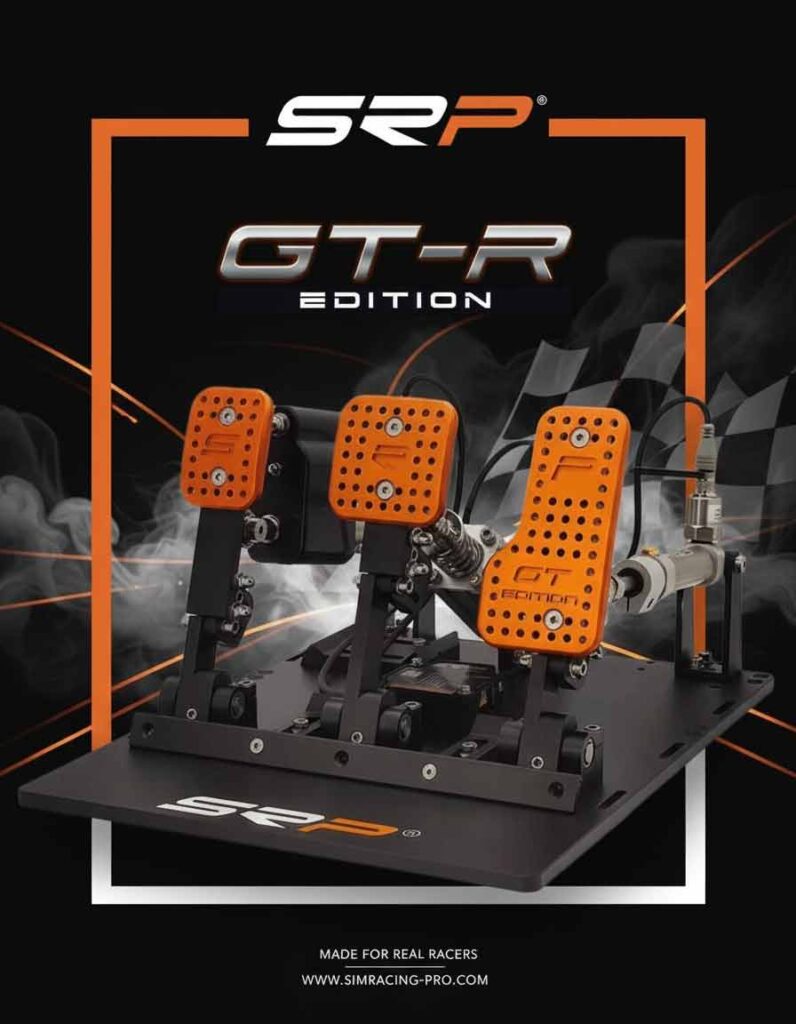
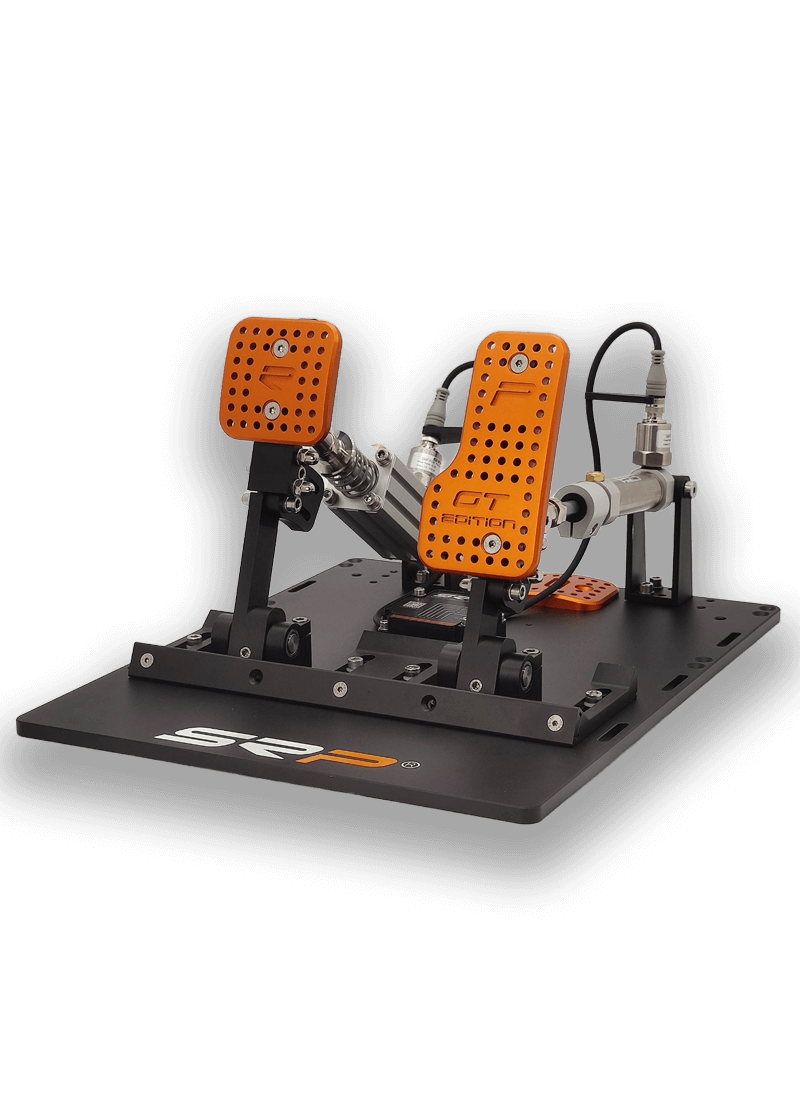
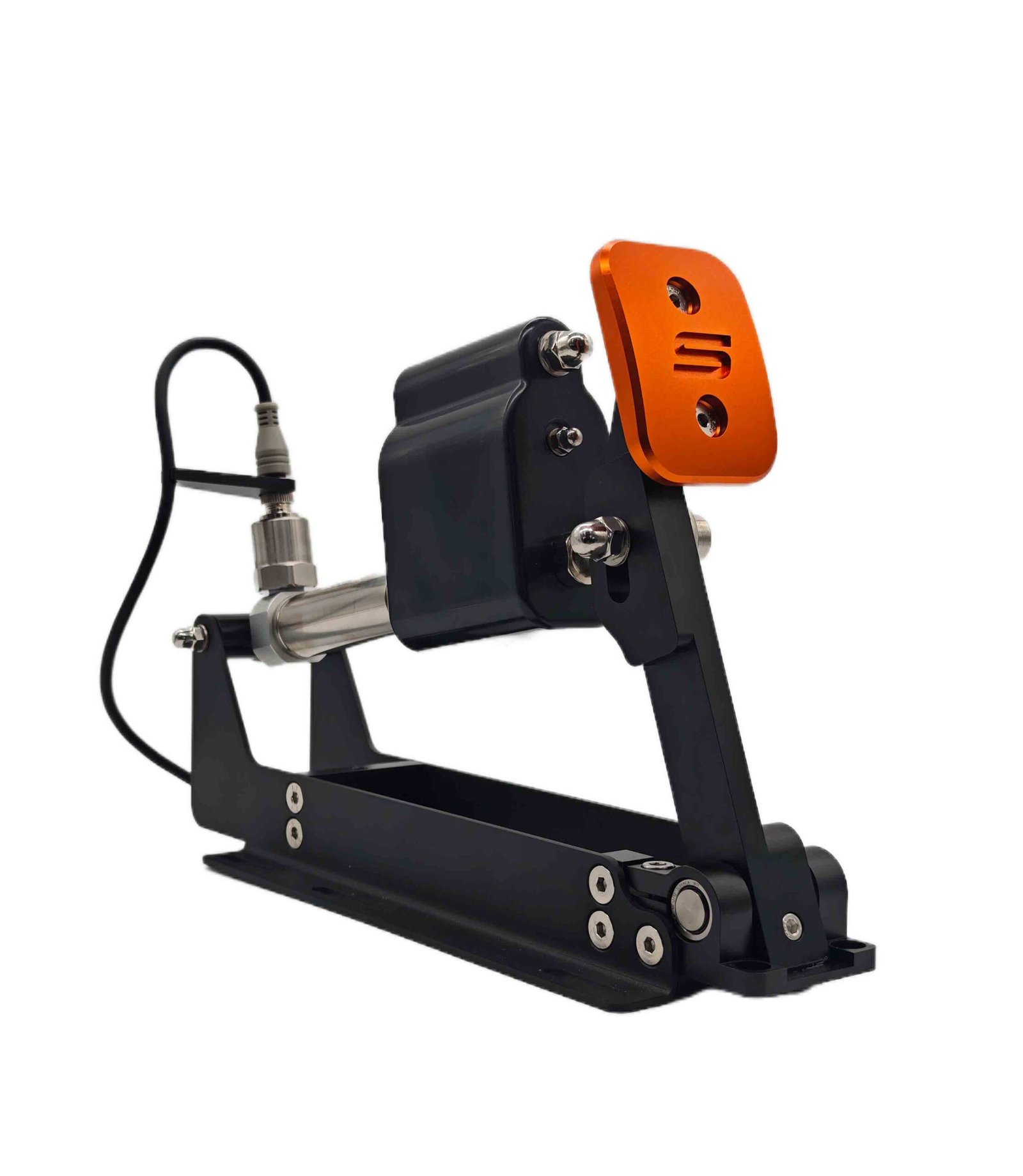
The load cell revolution was right: force sensing beats position sensing, full stop. We kept it. What we changed is everything upstream of the sensor — the part of the pedal your foot actually argues with. The SRP® R-Piston V5 replaces the elastomer stack with a hermetic air cylinder: the exponential force curve of a race master cylinder, a trail window measured in millimeters instead of fractions, and a resistance medium that cannot age, soften or fatigue.
It is the same reason professional drivers preparing real races — Miguel Molina (2024 Le Mans overall winner), Daniel Juncadella (Daytona 24h & Spa 24h winner), Albert Costa (Le Mans class winner) — train on these pedals daily: when the resistance medium is air, the only variable left in the braking equation is you. That is not a slogan; it is what happens when you delete the polymer from the load path.
Frequently Asked Questions
Are load cell pedals bad?
No — the best ones are genuinely excellent, and force sensing was the right revolution. This comparison is about what creates the resistance behind that sensor: a rubber elastomer stack that ages and heat-cycles, or a sealed air cylinder that cannot. If you own good load cell pedals and they serve you well, they are not holding you back the way early potentiometer pedals did.
Do elastomers really fade?
Honestly: less than internet debates suggest, especially modern thermoset compounds — Heusinkveld tests its latest elastomers to a million cycles without measurable degradation. But polymers still age, manufacturers still replace compounds over time, and small shifts at an 80 kg braking threshold are real. The drift-free claim is definitional for air, conditional for rubber.
Is 16-bit resolution noticeable over 12-bit?
Not step by step — both are finer than human perception. The practical difference is headroom: after dead-zone calibration and curve shaping, a 12-bit system has a few hundred usable steps in the trail band where a 16-bit system has thousands. It matters at the margins of tuning, not in raw feel.
What is the "brick wall" problem?
Entry load cell kits built around very hard elastomers with minimal travel — owners describe roughly 5 mm of movement. Great for hitting a repeatable maximum pressure; difficult for trail braking, where the whole technique lives in the first millimeters of release. Progressive stacks and pneumatic cylinders exist to give that zone physical space.
Is 65 kg of brake force enough?
For many cars, yes. Heusinkveld's own manual notes that top-level GT and quick formula cars require higher peak forces — which is why higher-tier pedals exist calibrated to 140 kg. SRP's pneumatic system produces resistance through pressure, not a rated cell ceiling, and travel is adjustable between 15 and 45 mm to tune the window.
Can I keep my load cell pedals and still improve trail braking?
Yes: soften the stack for more low-force travel, set a small dead-zone, and — most importantly — make your release deliberate. If you still feel the window is too small after tuning, that is the physics of the stack telling you its limits; a pneumatic cylinder is the upgrade that removes the limit rather than moving it.
Why do professional drivers train on SRP pedals?
For the same reason this post leads with the sensor/resistance split: pros already have force sensing everywhere. What they need from daily training hardware is a resistance curve that is identical on lap 1 and lap 100 — Molina, Juncadella and Costa use SRP precisely because compressed air does not have a wear schedule.
Sources & further reading
- Heusinkveld — Sprint Pedals Manual (Oct 2025): 120 kg cell, 65 kg max measurable, elastomer stack settings, peak-force candidness
- Heusinkveld Shop — Elastomer Kit Sprint: thermoset compound, 1M-cycle durability claim, earlier-spec "slightly different performance characteristics"
- Fanatec — CSL Pedals Load Cell Kit product page: 12-bit precision, 65 Shore elastomer stack
- Boosted Media — Heusinkveld Sprint Sim Pedals review (65 kg cell max-out discussion)
- GTPlanet Forums — Fanatec Load Cell is not what I expected (owner "brick wall" experiences, ~5 mm travel)
- r/simracing — Let's talk springs and elastomers (the counter-argument on fade magnitude)
- SRP® — Stiff vs Soft Sim Racing Pedals: Muscle Memory Guide
Keep learning: Pneumatic vs Hydraulic Pedals · Load Cell vs Pneumatic 2026 · How to Trail Brake · The Pneumatic Pressure Curve · SRP® Help Center