
/// Rally & Drift · Pneumatic Technology
Pneumatic Handbrake for Sim Racing
A pneumatic handbrake replaces springs and rubber with compressed air. The result is the closest thing to a real hydraulic e-brake you can bolt to a cockpit — progressive, repeatable and free of fluid. Here is how it works, and what separates a pro-grade unit from an entry-level one.
- AIRno springs
- 0fluid
- AL60615-axis CNC
- USB-Cplug & play
- 48Hin stock
If you drive rally stages or link drift zones, the handbrake is not an accessory: it is how you rotate the car. That is why more drivers are moving to a pneumatic handbrake for sim racing. But "pneumatic" on a product page tells you very little on its own. This guide explains the physics, and the engineering details that decide whether the feel lasts one season or ten.

// 01 · The physicsHow a pneumatic handbrake works
When you pull the lever, a piston travels inside a hermetically sealed cylinder and compresses the air trapped inside. Air resistance grows as volume shrinks, so the force builds progressively: light at the start of the pull, firm at the end. That is the same sensation a real hydraulic e-brake gives you as pressure builds in the caliper.
A sensor reads the position or pressure and sends it to the PC as an axis. The game sees a smooth 0–100% input, and your hand feels a natural force curve that matches it.
// 02 · Why airAir vs springs vs elastomers
| Resistance medium | Force curve | Over time | Fluid risk |
|---|---|---|---|
| Steel spring | Linear, flat feel | Loses tension, sags | None |
| Rubber / polyurethane elastomer | Progressive, but changes with heat | Softens and wears | None |
| Real hydraulic system | Realistic | Seals can fail | Oil leaks |
| Sealed pneumatic cylinder | Progressive, repeatable | Air does not fatigue | None |
For a deeper comparison of all technologies, read pneumatic vs hydraulic vs load cell handbrakes.
// 03 · Not all are equalWhat makes a high-performance pneumatic handbrake
A pneumatic cylinder is only the starting point. Entry-level units often pair it with laser-cut steel, cast parts or a basic potentiometer. These are the five details that make the difference under racing load:
Industrial cylinder & NBR seals
If air escapes, the curve drifts. The SRP® HB uses SRP-designed pistons in a sealed industrial cylinder.
Ceramic diaphragm transducers
Stable readings without the wear or noise of a cheap potentiometer.
100% AL6061 · 5-axis CNC
28 µm hard anodizing and polished SUS303 stainless shafts. No flex under a full pull.
SKF needle bearings
Smooth travel with zero play, so every millimetre of your hand reaches the sensor.
Throw, tension & tilt
All mechanical and tool-free, plus free HBsetup software for curves and profiles.
Rule of thumb: "adjustable hardness" alone is not enough. Look for a handbrake that adjusts throw, tension and ergonomics independently, and lets you shape the output curve in software.
// 04 · On trackWhat you feel in rally and drift
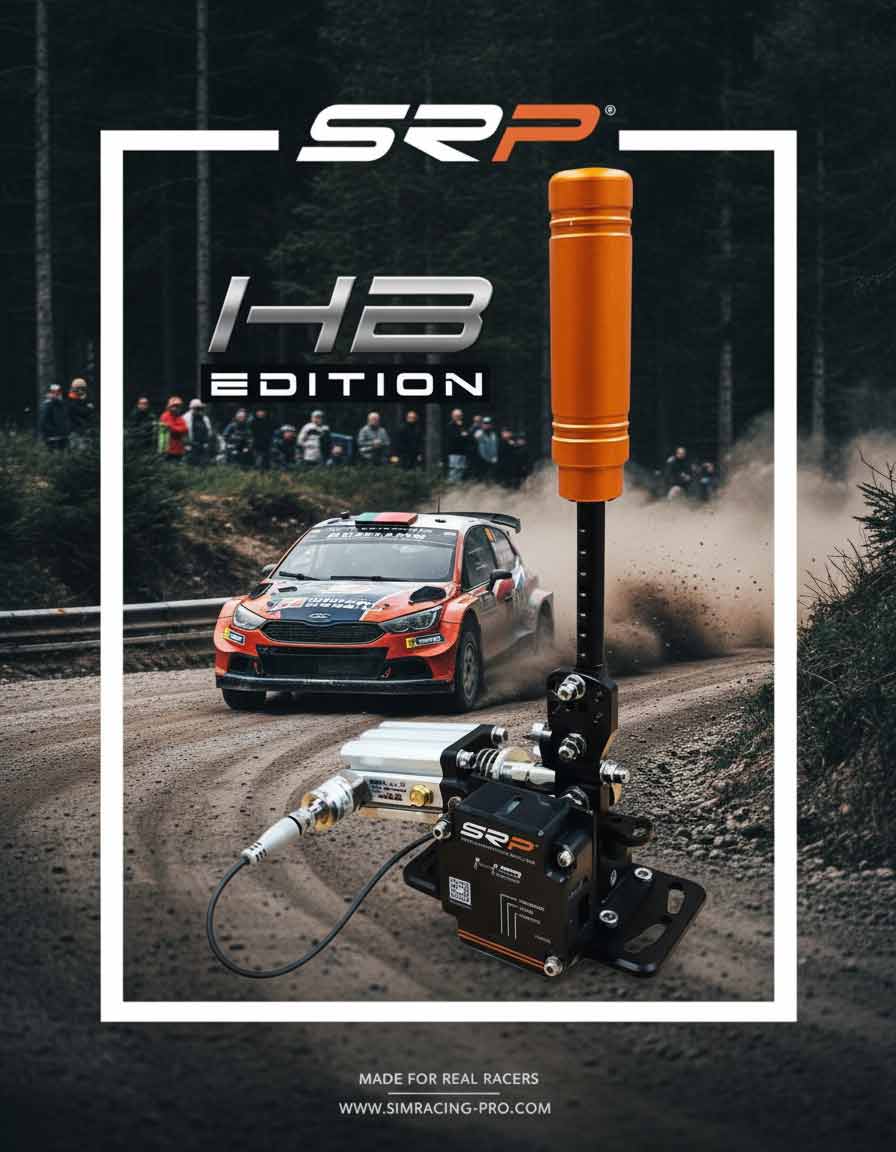
In rally, the handbrake is a tool for hairpins and Scandinavian flicks: you need a fast, short pull that locks the rear exactly when you ask. In drift, you need modulation: a long progressive pull to extend an angle or correct a transition. A pneumatic curve handles both because force rises with travel — you can feel where you are in the pull without looking. Our rally and drift handbrake guide covers technique and settings for each discipline.
// 05 · Before you buyChecklist for a pneumatic handbrake
- Materials: full CNC aluminium, not stamped steel.
- Sensor: ask what reads the input, and how it is calibrated.
- Adjustment: throw, tension and grip angle, ideally without tools.
- Software: curves and saved profiles for each discipline.
- Mounting: a universal bolt pattern for 80/20 profile cockpits. See our handbrake mounting guide.
- Warranty and stock: a real warranty and units ready to ship, not a pre-order.
The SRP® HB pneumatic handbrake ticks every box: designed, machined, anodized and assembled in Barcelona, in stock and shipping in 48h, with 3 years of warranty in Spain and 2 years internationally. For the full buying guide, see the best handbrake for sim racing.
// FAQFrequently asked questions
What is a pneumatic handbrake in sim racing?
It is a handbrake whose resistance comes from compressing air inside a sealed cylinder instead of a spring or rubber elastomer. The air builds force progressively, like a real hydraulic e-brake, without any fluid.
Is a pneumatic handbrake better than a spring handbrake?
For rally and drift, yes. A spring gives a linear push that never changes character, and it sags over time. Compressed air builds force progressively and does not fatigue, so the feel stays the same after thousands of pulls.
Does a pneumatic handbrake need maintenance?
A well-sealed unit does not. The SRP® HB uses a hermetically sealed industrial cylinder with NBR seals, so there is no fluid to top up and no elastomer to replace.
Are all pneumatic handbrakes the same?
No. The cylinder sealing, the sensor, the machining tolerances and the adjustment system decide how precise and durable the unit is. Check the materials, the sensor type, the warranty and how the tension is adjusted before buying.
Does the SRP® HB work with consoles?
It is native to PC via USB-C. Console use requires a compatible adapter ecosystem.
Feel the air
Pneumatic resistance, CNC aluminium and USB-C plug & play. In stock, ships in 48h.
View SRP® HB — from €336Custom knobs