
O Apex (Linha de Corrida)
One point inside the corner decides how fast the next straight begins. What the apex really is, what professional and sim telemetry actually show about it, and the release-phase technique that separates podium laps from near-misses.
Definição
Por que um único ponto determina toda a curva
A corner is a compromise between two goals: carrying speed into it and launching speed out of it. The racing line resolves it by using the full width of the track — wide entry, clip the inside at the apex, wide exit — creating the largest possible radius. At a fixed grip level, radius is speed. Any line that tightens the arc forces the tires to work harder and the driver to slow down more. That part is physics, and it is not negotiable.
The second part is strategy, and it is where most drivers get it wrong: corners are won at the exit. Nigel Mansell put it in lap-time terms that data teams still quote — carry one mph more on corner exit and you keep that speed all the way down the next straight. Mid-corner speed that gets bled off before the next braking zone is worth almost nothing by comparison.
What Telemetry Actually Shows
Strip away opinion and the data from real F1 traces and sim telemetry platforms tells a remarkably consistent story about the apex. These are the findings coaches and race engineers keep returning to:
Ápice precoce × Geométrico × Tardio
There is no single correct apex — there is a correct apex for each corner, and it is dictated mostly by what comes after it:
| Linha | Onde você prende | Minimum speed | Velocidade de saída* | Use-o quando |
|---|---|---|---|---|
| Ápice precoce | Antes do meio | Reached before the apex — you then wait, tight exit | ~96 km/h | Segue-se uma reta curta, curvas fechadas ou uma posição defensiva |
| Geométrico | Exatamente no meio | At the apex — balanced entry and exit | ~106 km/h | Learning a corner, corners between equal straights, fast corners where the car has nothing left to accelerate to |
| Ápice tardio | Depois do meio | After the apex — sacrifices mid-corner for a straightened exit | ~114 km/h | Qualquer reta longa que se seguir — o padrão nas corridas |
* Illustrative exit speeds from our visualizer below — the exact numbers change per corner and car balance; the ranking never does.
Laboratório interativo — Veja as três linhas
O Visualizador da Linha de Corrida
Same corner, three apex choices. Switch between them and watch how the line — and the speed you carry onto the straight — changes. Blue ghosts show the alternatives; the telemetry bars below compare exit speed and the illustrative time cost over a 300 m straight.
/// Telemetry comparison
The Phase Nobody Talks About: Releasing the Brake
Every coaching video covers the braking point. Almost none cover the braking release — and telemetry says that is where the seconds are. Trail braking means carrying brake pressure into the turn-in, then bleeding it off progressively while the steering builds. The release shifts weight back to the rear, lets the front rise, and decides how much rotation the car finds at the apex. Published sim telemetry guides describe it precisely: only when the brake is fully and cleanly released does the driver reach maximum steering angle — requesting all the front grip only once the rear is planted again.
Two failure modes show up in every data trace. Release too early and the car under-rotates, you add steering, scrub speed, and your minimum speed arrives before the apex — the 138 km/h scenario. Release too late or too abruptly and the nose stays loaded, the rear goes light, and the car oversteers on entry. The fast trace — the Hamilton trace — is a single smooth ramp of pressure from threshold braking down to zero, timed so the last percent of release happens as the car rotates onto the exit.
Here is the uncomfortable physics of pedal hardware: a release is only repeatable if the pedal's pressure-versus-travel curve is identical every lap. Rubber elastomers heat up across a stint and soften — the same pedal position that gave 80% pressure on lap 1 gives measurably less on lap 30, and your muscle memory is now braking for a pedal that no longer exists. This is the thermal fade documented in comparative hardware tests.
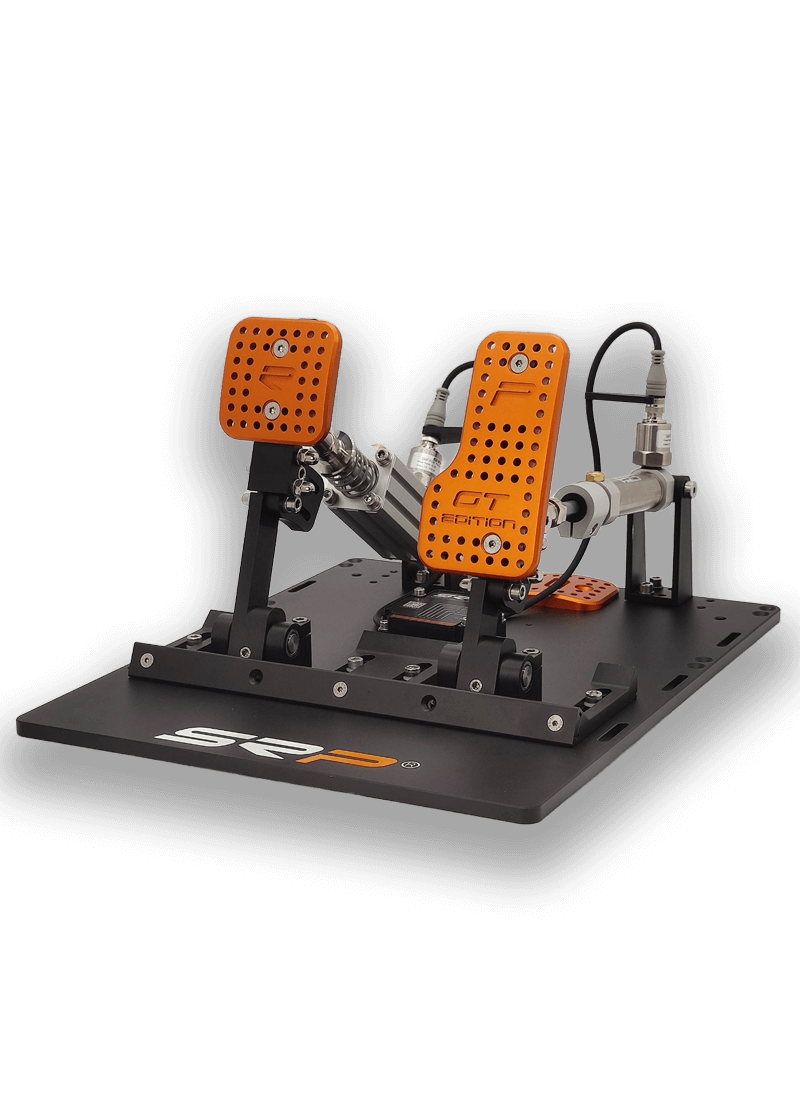
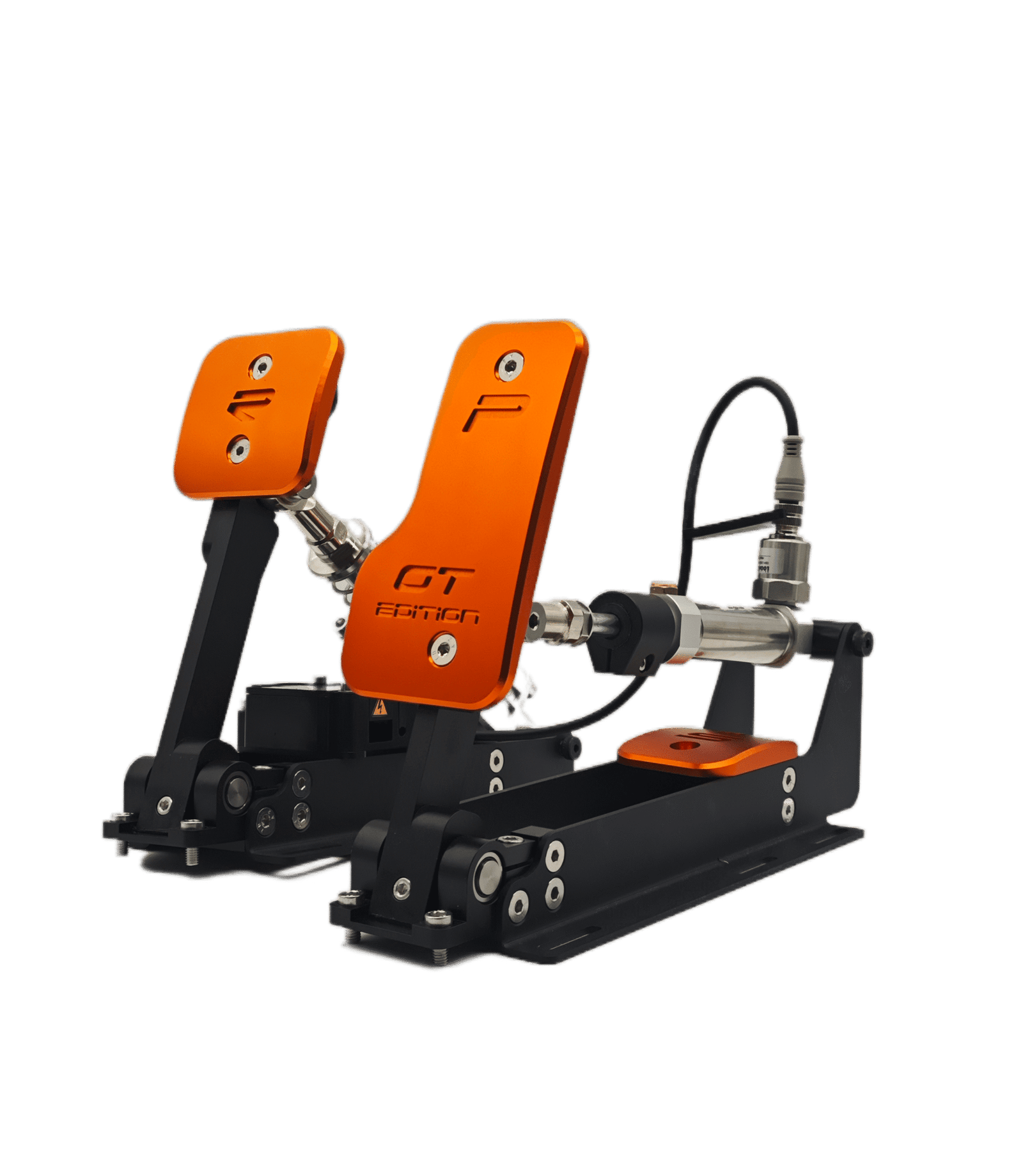
It is exactly why professional drivers training for real races — Miguel Molina (2024 Le Mans overall winner), Daniel Juncadella (Daytona 24h & Spa 24h winner), Albert Costa (Le Mans class winner) — use pressure-based pneumatic pedals such as the SRP® GT-R and GT-S for daily sim work: air compression does not fatigue with temperature, so the release curve of lap 100 is the release curve of lap 1, sampled at 65,536 pressure steps. When your brake pedal's release is the one input the whole apex procedure depends on, consistency is not a luxury — it is the speed itself.
Interactive Lab — The Fade You Can't Feel
Brake Release Consistency Simulator
Drag the stint slider and watch what heat does to a rubber-elastomer brake curve versus a pneumatic one. The dashed line is what your foot memorized on lap 1 — the gap at your habitual release point is speed you lose without ever knowing why.
Como dar o máximo em todas as voltas
Consistency at the apex is procedure, not talent. Professionals build every corner from fixed references: a braking marker, a turn-in point, the apex itself, and an exit marker. Vision does the fine work — look at the apex before you turn in, and at the exit before you reach the apex. The car goes where your eyes go; every driving school and every telemetry overlay agree on this.
Then comes the part hardware decides: hitting the same apex lap after lap requires hitting the same braking point with the same pressure, and — per the release phase above — releasing it on the same curve. Feeling the front tires load up through Force Feedback tells you how much entry speed the apex will accept. A correct field of view makes the distances real: set it up with our FOV calculator. And a pressure-based brake is what turns the release from an approximation into a repeatable, trainable input.
Perguntas frequentes
O que é o ápice nas corridas?
The apex is the point on the inside of a corner that the car passes closest to — also called the clipping point. The racing line (wide entry, apex, wide exit) is built around it to maximize corner radius, and therefore speed.
Why is the late apex faster before a long straight?
Because it sacrifices mid-corner speed to straighten the exit. Telemetry comparisons consistently show the faster driver reaching minimum speed at or after the apex and carrying several km/h more onto the straight — and that speed is multiplied by the full length of it. The geometric line balances entry and exit; the early apex gives a tight, slow exit that only works when almost no straight follows.
What does "minimum speed placement" mean?
It is where in the corner your lowest speed occurs. Reaching minimum speed before the apex means you waited too long at low speed and delayed your throttle. Reaching it at or just after the apex means the car spent the shortest possible time slow. In published telemetry comparisons this single difference was worth 4 km/h at the exit.
O vértice é o mesmo que o ponto de recorte?
Yes — two names for the same thing: the moment the car passes closest to the inside edge of the corner.
Why does brake release matter more than the braking point?
Because the release controls rotation and weight transfer through the apex. Release too early and you under-rotate and scrub speed; too late and the rear goes light and oversteers. Data guides describe the fast trace as one smooth pressure ramp to zero, finishing as the car rotates onto the exit — and it is only repeatable if the pedal curve does not change with temperature.
Como faço para atingir o ápice de forma consistente?
Fixed references (braking marker, turn-in, apex, exit), early vision — apex before turn-in, exit before apex — and a brake pedal whose pressure curve is identical every lap. Consistency in the pedal is what makes the whole procedure repeatable.
O ápice é importante no jogo “ sim racing ”?
Exactly as much as in real racing. iRacing, ACC and rFactor 2 reward the same radius and exit-speed physics, and their telemetry tools (MoTeC, VRS, TrackTitan) expose the same minimum-speed and release-phase metrics race engineers use in real motorsport.
Sources & further reading
- Driver61 — How to Trail Brake and racing-line tutorial (Mansell): driver61.com/uni/trail-braking
- TrackTitan — How to Analyse Telemetry for Sim Racing: apex minimum speed and exit-speed comparison
- Autosport Forum — Telemetry Analysis of Lewis Hamilton (Massenet/Casino, Monaco speed traces)
- SimRacingTelemetry Docs — Analyzing Racing Lines in Telemetry Data
- The Field F1 — F1 Telemetry Data & Charts Explained (throttle/brake trace, trail braking overlap)
- simracingcockpit.gg — Racing Line Explained: Late vs Geometric Apex
- iRacing telemetry guides — trophi.ai / Braking Lab (braking zone and release smoothness metrics)
Continue aprendendo: Force Feedback (FFB) · Direct Drive (DD) · Calculadora de FOV · Rev-Matching e Telemetria · Central de Ajuda do SRP®