
Graining and Blistering Explained
The Core Definition
Graining is surface abrasion caused by cold rubber sliding and tearing.
Blistering is internal overheating that causes the tire carcass to literally bubble and burst open.
How They Destroy Your Lap Times
Understanding Graining
Graining typically happens early in a stint. When you push a car before the tires are up to their optimal operating window, the rubber is hard and brittle. If you lock the brakes or aggressively turn the wheel, the tire slides laterally across the tarmac. This friction rips tiny pieces of rubber away from the surface, which then roll up into little “pills” that stick to the tread. The result? You are essentially driving on marbles, drastically reducing your mechanical grip.
Understanding Blistering
Blistering is the opposite extreme. It happens when the core of the tire gets dangerously hot, often due to excessively high tire pressures, continuous heavy braking, or sustained high-speed cornering. If the internal heat generates faster than the surface can cool it down, the rubber boils and bursts through the surface, leaving literal craters in your tire. Once a tire blisters, the stint is effectively over.
The Hardware Disconnect: Solving it with SRP®
In sim racing, feeling tire graining through force feedback is crucial. But feeling the exact brake pressure to avoid locking up and causing graining requires ultra-precise pedals. Learn how SRP pneumatic pedals help you manage tire wear.
Preventing tire abuse requires silky-smooth, mathematically consistent inputs. Standard elastomer (rubber) pedals change stiffness as they heat up during a race, meaning your muscle memory will betray you right when the tires are most vulnerable. The industrial 16-bit sensors combined with our proprietary pneumatic cylinders allow you to modulate the throttle and trail-brake with absolute fidelity.
Community FAQ: Hardware vs Technique
In high-level eSports and 24-hour endurance events on platforms like iRacing or ACC, you cannot afford to rely on equipment that degrades. By transitioning to an industrial-grade pneumatic architecture, you ensure that your physical inputs are translated with absolute mathematical perfection.
Master Tire Management Today
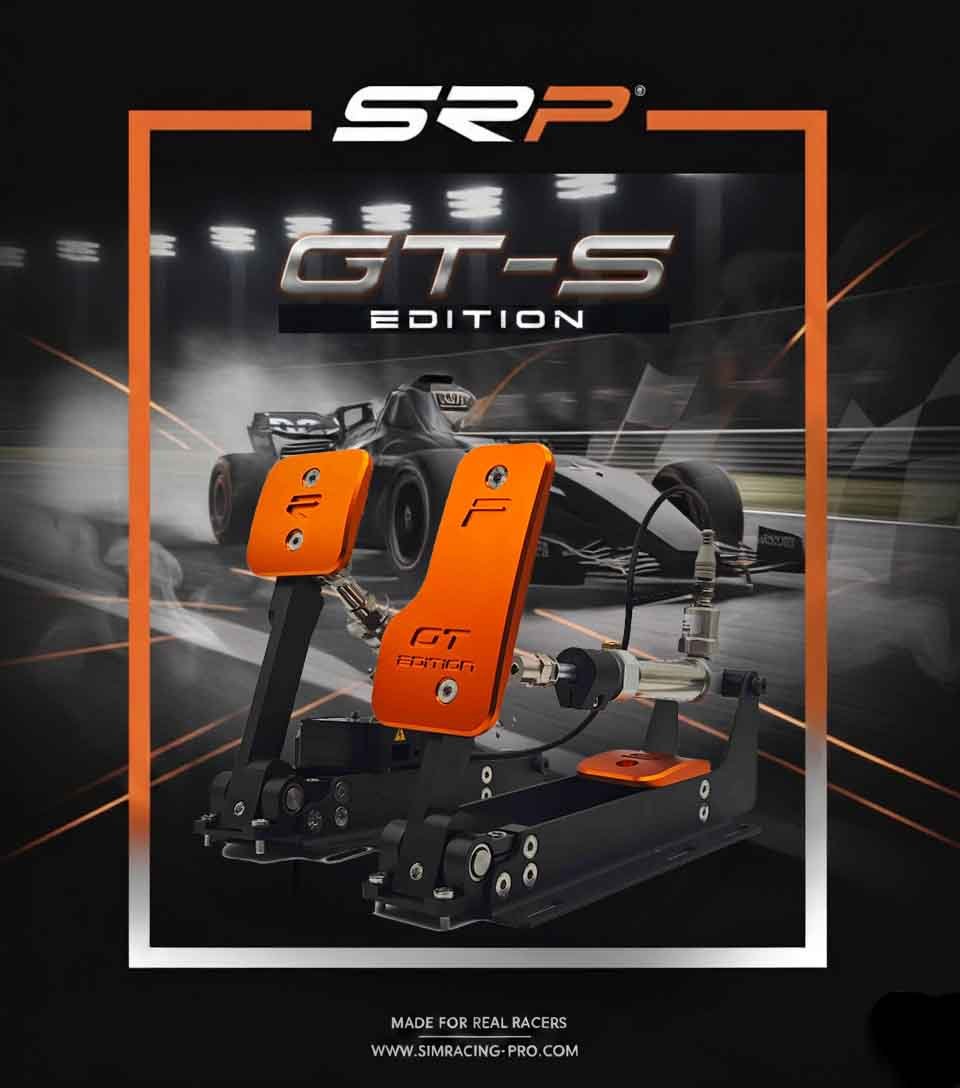
Stop fighting degrading rubber elastomers and inconsistent brake pressure. Upgrade to the SRP® GT-S Pneumatic Edition and secure your muscle memory with aerospace-grade precision.
Discover SRP® GT-S