
Active pedals (also called force feedback or FFB pedals) replace springs, elastomers or fluid with an electric motor that pushes back against your foot, and software decides how hard. Passive pedals create their resistance mechanically, and on a real race car the brake pedal is always passive.
Active pedals are the newest trend at the top of the simulator market, and they sit at a much higher price point than premium passive sets. Before you invest, it is worth asking a motorsport question: does replacing mechanical physics with a motor and software make you faster, or does it just make the pedal feel different? Let's break down the active vs passive debate.
How Active Force Feedback Pedals Work
An active pedal has no traditional resistance element. Instead, an electric motor (similar in concept to a Direct Drive wheelbase) pushes back against your foot. Software tells the motor how much force to apply at each point of the travel, simulating the resistance curve of a brake pedal.
Because the force is generated electronically, it can be changed per car and the motor can also vibrate, simulating effects such as the pulsing of an Anti-lock Braking System (ABS) or wheel lock-up.
Real Race Cars Use Passive Pedals
Here is the point that often gets lost in sim racing marketing: real GT3, single-seater and prototype cars do not have motors on their brake pedals.
With an active pedal, every response passes through a control loop: a sensor reads your foot, software calculates a force and the motor applies it. However refined that loop is, the resistance is calculated rather than physical. For drivers chasing the feel of a real master cylinder, that is a step away from authentic motorsport.
Active vs Load Cell vs Hydraulic vs Pneumatic
Most high-end pedals fall into four technologies. They differ in what creates the resistance and in what the sensor measures. For a deeper look at the sensors, see our guide to sim racing pedal sensors.
| Active (FFB) | Load cell | Hydraulic | Pneumatic (SRP®) | |
|---|---|---|---|---|
| Resistance source | Electric motor | Springs and elastomers | Hydraulic cylinder or damper | Compressed air in a sealed cylinder |
| What is measured | Position and force, fed to software | Force on the load cell | Force or fluid pressure | Air pressure (16-bit ceramic sensor) |
| Feel | Programmable per car | Depends on the elastomer stack | Damped, fluid feel | Light at the top, progressively firmer |
| Software dependency | Required to create the force | Only for curves and calibration | Only for curves and calibration | Only for curves and calibration |
| Parts that wear | Motor, electronics | Elastomers and springs | Seals and fluid | No elastomers or springs |
| Effects in the pedal | Yes (ABS, lock-up) | No | No | No (handled by wheelbase and transducers) |
If you are weighing passive options, our pneumatic vs load cell pedals guide and the sim pedals comparison guide go into more detail.
The Purist Approach: Real Fluid Resistance
If you want the feel of a real race car, you do not need a motor; you need a proper mechanical system. This is where high-end passive pedals, and specifically pneumatic sim racing pedals, stand out.
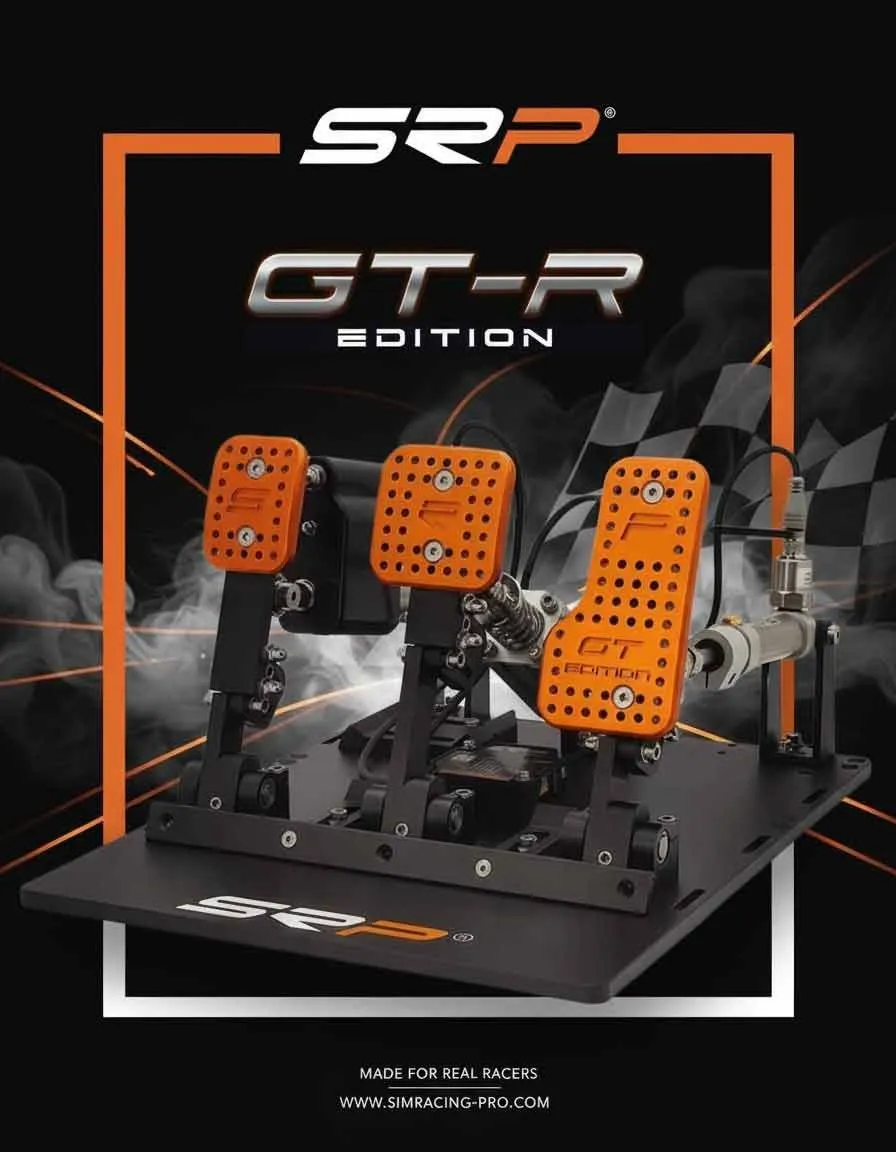
The SRP® GT-R uses our R-Piston V5. Instead of software deciding how much resistance to apply, the pedal compresses air in a sealed aluminium cylinder. Air is a fluid: the more you compress it, the firmer it gets, creating a progressive wall of pressure that comes from physics, not from a calculation. A ceramic sensor reads that pressure in 16-bit, with no elastomers or springs to wear.
You get mechanical feedback with no motor or software in the force path, at a fraction of the cost of motorized active pedals.
What About Feeling the ABS?
In real racing, drivers detect lock-up and ABS through chassis vibration, steering weight and sound. In sim racing, your Direct Drive wheelbase, tactile transducers (bass shakers) and good audio give you that information without needing the pedal itself to vibrate. Our braking technique guide explains how to manage threshold braking and ABS.
Keeping the pedals purely mechanical also keeps them simple: no motor to power or cool, no pedal firmware to update and nothing that can change its behaviour in the middle of a long endurance stint.
Force Feedback Clutch and Throttle?
Some active pedal systems also offer motorized clutch and throttle pedals, simulating the clutch bite point or traction control vibrations. On passive pedals, the clutch feel comes from its mechanical design and the bite point is set with curve settings in software, which is how most drivers set it up for consistent starts.
Who Should Buy Active Pedals?
Active pedals make sense if you want to change the pedal feel for every car you drive, you value vibration effects in the pedal itself, and the price, external power and firmware updates are not a concern. If your priority is a brake that feels and behaves like a real race car pedal, lap after lap, a high-end passive pedal is the more direct route.
Frequently Asked Questions
What are active pedals in sim racing?
Active pedals, also called force feedback or FFB pedals, replace springs, elastomers or fluid with an electric motor that pushes back against your foot. Software decides how much force the motor applies, so the pedal feel can be changed per car and can include vibration effects such as ABS.
Do professional drivers use force feedback pedals?
Real GT3, single-seater and prototype cars have no motor on the brake pedal: the resistance comes from the hydraulic brake system. Simulators built to train real drivers aim to reproduce that, so they typically rely on passive hydraulic or pneumatic resistance rather than a motor.
Are pneumatic pedals considered active or passive?
Pneumatic pedals are passive. The SRP® R-Piston V5 generates resistance by compressing air in a sealed aluminium cylinder, with no motor and no software creating the force. A sensor only measures the pressure you apply.
Are force feedback pedals worth it?
They can be worth it if you want a programmable pedal feel per car and vibration effects in the pedal itself, and the budget, power supply and firmware updates are not a concern. If your goal is a brake that behaves like a real race car pedal, a high-end passive pedal delivers that feel for considerably less.
Do active pedals make you faster?
Lap time comes from consistent, repeatable braking pressure. Active pedals do not add grip or braking performance; they change how the pedal feels. A passive pedal with a progressive, stable resistance curve lets you build the same muscle memory every lap, which is what makes drivers faster.
What is the difference between active and load cell pedals?
A load cell pedal is passive: springs or elastomers create the resistance and a load cell sensor measures the force you apply. An active pedal uses a motor to create the resistance. Pneumatic pedals are a third option: compressed air creates a progressive resistance and a pressure sensor reads it.
Experience pure mechanical realism, without a motor in the force path.
Discover the SRP® GT-R pedals