
Sim Racing Ergonomics and the Impact of TRIPLE SCREEN GEOMETRY
Global SimRacing Engineering & Mastery
[EXECUTIVE BRIEFING] In the highly competitive ecosystem of professional SimRacing, the margin between standing on the podium and suffering a DNF often hinges on complex technical variables, none more critical than triple screen geometry. For years, the sim racing community has been captivated by the arms race of Direct Drive wheel bases and ultra-wide, high-refresh-rate monitor setups. However, the most vital connection between the driver’s intent and the virtual chassis—the braking and kinetic telemetry—has been severely neglected by mainstream manufacturers.
To truly understand triple screen geometry, we must step away from marketing buzzwords and delve into the fundamental physics of kinetic energy management. When a pilot approaches a heavy braking zone at 280 km/h, the simulator calculates weight transfer, tire deformation, and aerodynamic downforce in real-time. If your pedal hardware cannot accurately and consistently relay your physical input to the software, you are driving blind. This educational deep-dive aims to equip you with the engineering knowledge necessary to evaluate your hardware, understand the root causes of inconsistency, and ultimately decide how to upgrade your rig to meet the demands of elite virtual motorsport.
/// THE SCIENCE OF PROGRESSIVE BRAKE FEEL
How 16-Bit Sensors Obliterate USB Polling Lag
To understand how to improve, we must first dissect the primary bottleneck in modern consumer hardware: Thermal Drift and Mechanical Softening. The vast majority of sim racers currently utilize Load Cell pedals equipped with polyurethane elastomers or heavy-duty metal springs. The theoretical goal of these materials is to mimic the stiff, progressive resistance of a real-world hydraulic master cylinder. However, this relies on a deep mechanical compromise.
Elastomers are inherently designed for shock absorption, not for the precise modulation of kinetic energy. As you push deep into a 2-hour endurance stint, repeatedly applying 80kg to 100kg of force corner after corner, internal friction within the rubber generates significant heat. This thermal buildup alters the material’s ‘Shore Hardness’, causing it to soften.
From an educational standpoint, this means the physics of your pedal are literally changing while you drive. The pedal travel distance required to reach 80% braking capacity on Lap 1 will be entirely different from the distance required on Lap 45. Your brain and central nervous system are desperately trying to build muscle memory, but your hardware is actively sabotaging that process through thermal degradation. When analyzing triple screen geometry, relying on shifting materials makes achieving peak performance mathematically impossible.
💡 DEEPEN YOUR ENGINEERING KNOWLEDGE
Explore our related technical analysis on maximizing simulator performance.
/// THE MATHEMATICAL TRUTH OF EXPONENTIAL RESISTANCE
Aerospace Aluminum: Eradicating Pedal Plate Flex
In response to the flaws of elastomers, the sim racing market has recently seen a surge in ‘Active Pedals’—motorized systems that utilize Force Feedback (FFB) servos to artificially generate pedal resistance. While visually and digitally impressive, as engineers, we must objectively analyze the drawbacks of this approach.
By replacing a physical rubber stopper with an electric motor, you are trading mechanical inconsistency for digital latency. A motorized pedal requires a processor to read your input, calculate the desired resistance via software algorithms, and physically instruct a servo to push back against your foot. This introduces unavoidable milliseconds of lag, potential USB polling noise, and the constant risk of software crashes or ‘Netcode’ misinterpretations during a sanctioned eSports event.
True motorsport relies on the undeniable, instant laws of fluid dynamics. Simulating reality through an algorithm creates a synthetic feel that your central nervous system recognizes as artificial. When battling for an apex, you do not want firmware calculating your resistance. You need native, organic physics.
/// PNEUMATIC SUPREMACY VS. MECHANICAL COMPROMISE
The Illusion of Progressive Resistance in Rubber
This brings us to the definitive engineering solution, and the core philosophy behind SRP®: Industrial Pneumatics. To truly master triple screen geometry and permanently eliminate the variables of Thermal Drift and Mechanical Softening, we had to discard both melting elastomers and lagging digital motors. We turned to the only element in the universe that does not degrade under repetitive compression: Atmospheric Air.
By compressing air within a hermetically sealed cylinder, we recreate the exact exponential pressure curve of a real race car’s hydraulic system. Air compresses predictably, linearly, and infinitely. It does not suffer from thermal fade, meaning the pedal resistance you feel on the starting grid is mathematically identical to what you will feel crossing the finish line 24 hours later.
To ensure this physical purity translates flawlessly into the simulator, SRP® houses this pneumatic architecture inside a zero-flex, aerospace-grade AI6061-T6 aluminum monocoque. The raw pressure is read by 16-bit industrial transducers, delivering 65,536 steps of ultra-precise, latency-free telemetry. By upgrading to a pneumatic ecosystem, you stop fighting your hardware’s flaws and start driving the car. You secure your muscle memory, optimize your trail braking, and engineer your victory.
Recommended Arsenal for triple screen geometry

SRP® GT-R
The Endurance Protocol. Engineered to survive 24h stints with zero thermal degradation. The ultimate cure for inconsistent braking.
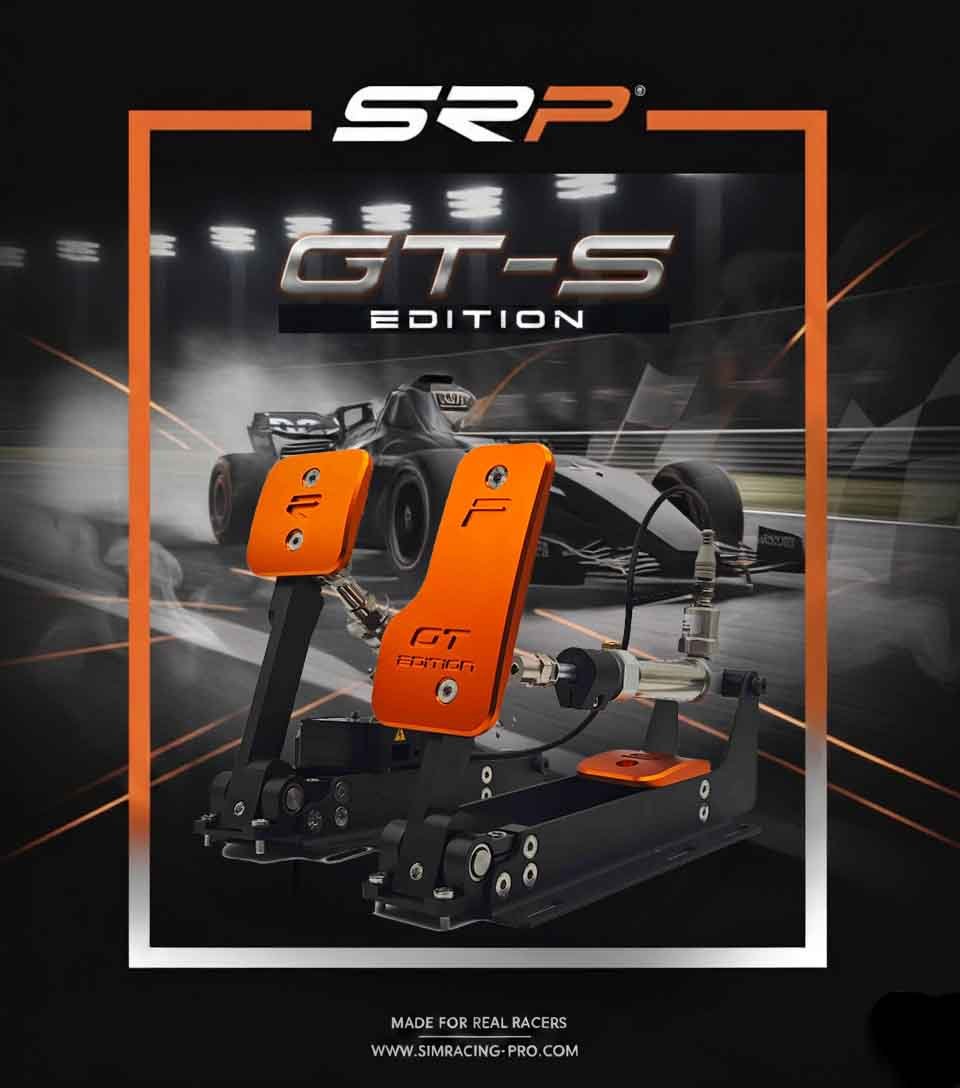
SRP® GT-S
GT3 & Rally Precision. Master every apex with pneumatic linearity and high-speed response. Say goodbye to elastomer fade.
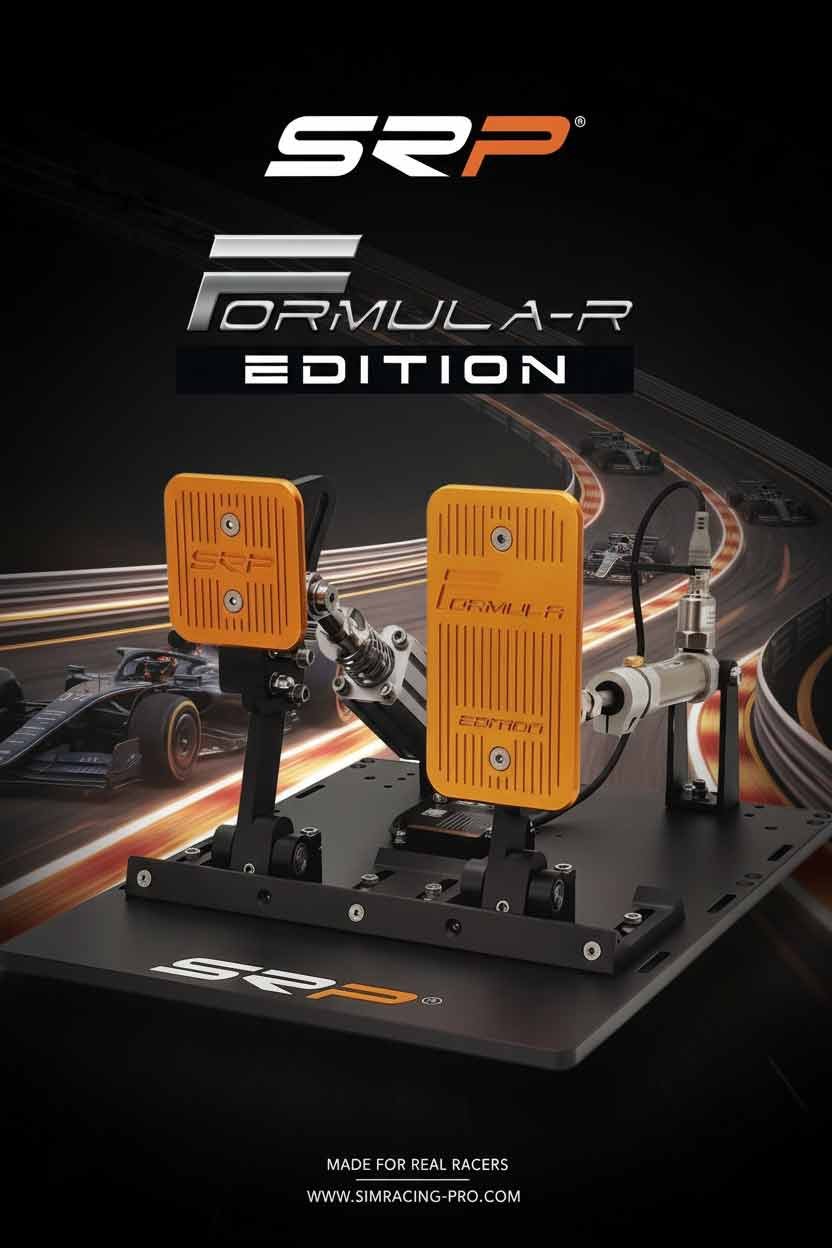
SRP® Formula-R
Ultimate Monocoque Rigidity. The Formula-R eliminates pedal plate flex for extreme high-downforce maneuvers.