
You just spent serious money on a set of high-end sim racing pedals. You bolt them to your rig, boot up iRacing or ACC, and head out on track expecting to instantly shave half a second off your personal best. But instead, your braking feels vague, your trail braking is inconsistent, and you keep missing the apex. The culprit? Pedal Flex.
What Exactly is Pedal Flex?
In the real world of GT3 or Formula racing, brake pedals are mounted to a solid, immovable carbon fiber or steel bulkhead. When the driver presses the brake with 100kg of force, 100% of that energy goes directly into the master cylinder.
In sim racing, "pedal flex" occurs when the structure holding your pedals—whether it's a desk floorboard, a cheap tubular chassis, or a thin metal pedal plate—bends or shifts under heavy braking force. If you apply 80kg of pressure and your pedal plate bends down by even 5 millimeters, you are losing crucial tactile data.
How Flex Destroys Trail Braking
Trail braking is the delicate art of slowly releasing brake pressure as you turn into the apex of a corner. It balances the car's pitch and keeps weight on the front tires for grip.
If your rig has pedal flex, your chassis acts like a giant, unwanted spring. When you start to release the brake pedal, the first thing that happens isn't the brake pressure dropping; instead, the bent metal of your rig "un-bends" and pushes back against your foot. This creates a disconnect between what your foot is doing and the telemetry signal being sent to the simulator.
You lose the millimeter precision required to bleed off the last 5% of brake pressure, causing you to understeer wide or randomly lock the inside tire.
The "Spongy" Illusion: Many drivers mistakenly believe their load cell elastomers are "too soft" or "spongy." Before changing your elastomers or pedal settings, mount a smartphone camera looking at your pedal plate from the side. Record a video while you execute a threshold braking maneuver. If you see the baseplate dipping or the uprights twisting, you don't have a pedal problem—you have a structural rigidity problem.
The 160kg Reality Check
Entry-level pedals mask chassis flex because they rely on potentiometers (measuring distance) and very soft springs. But the moment you step up to professional-grade hardware, structural integrity becomes mandatory.
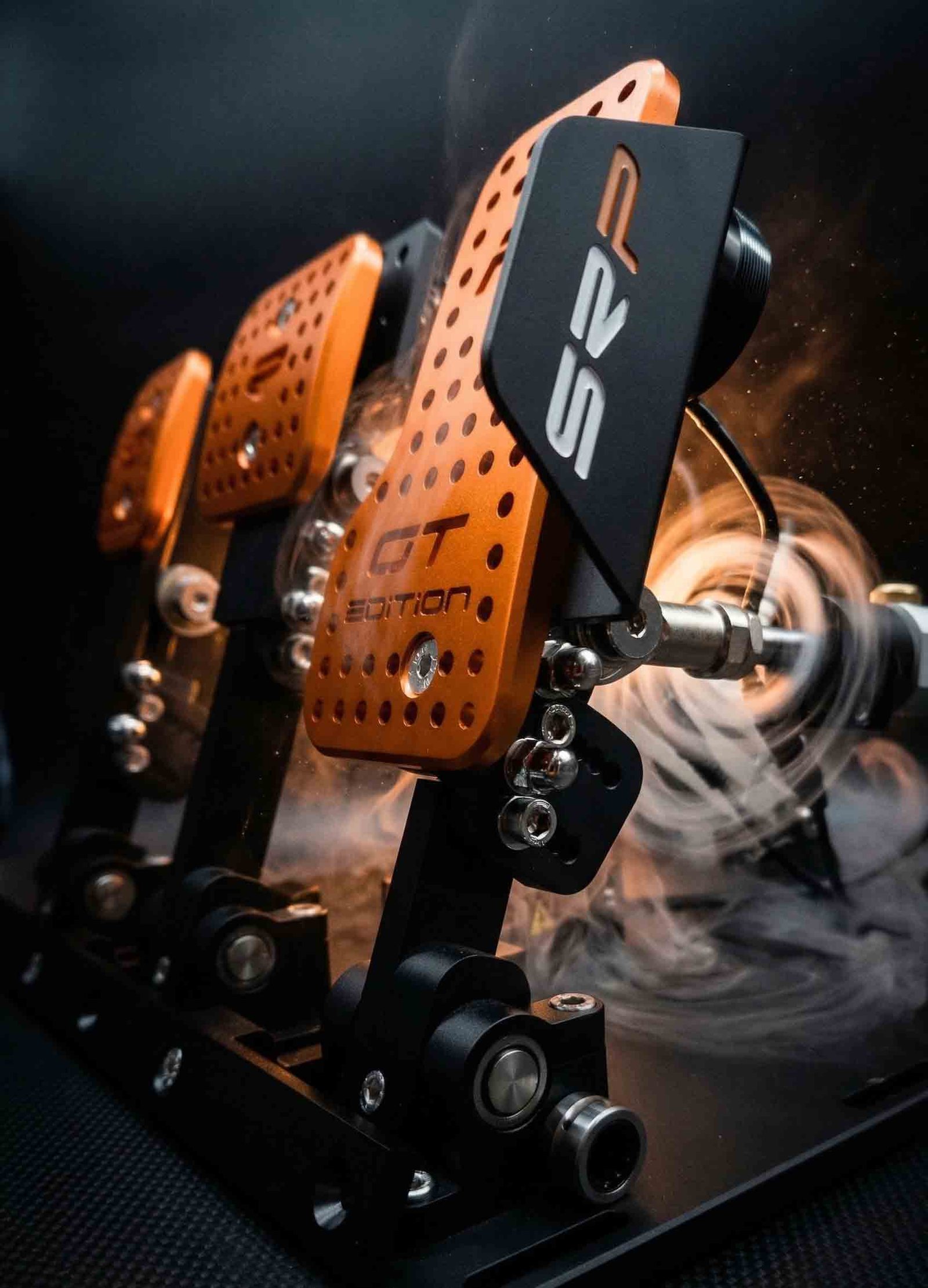
Take the SRP® GT-R Pneumatic Pedals, for example. Our custom R-Piston v5 pneumatic cylinder is designed to handle immense, authentic braking forces—replicating the stiff, immovable wall of a real race car. If you mount a pedal capable of handling 160kg of force onto a rig that bends at 40kg, you are essentially driving a Ferrari on bicycle tires.
How to Fix Your Setup
If you want to unlock the true potential of your muscle memory, you must eliminate flex. Here is the hierarchy of pedal mounting:
- Level 1 (Unacceptable): Pedals on the floor or mounted to a thin, single-arm tubular wheel stand.
- Level 2 (Compromised): Entry-level sim rigs with thin stamped steel pedal plates. You will need to add custom reinforcement brackets underneath.
- Level 3 (Optimal): Aluminum extrusion (8020 profile) rigs with a thick, reinforced pedal deck. This is the gold standard for high-end pneumatics.
The Verdict
High-end pedals don't make you faster on their own; they give you the capacity to be faster by providing a consistent platform for your muscle memory. But if your rig flexes, that consistency is impossible.
Secure your rig, eliminate the flex, and then experience the true zero-fade, high-pressure precision of a pneumatic braking system.
Is your rig ready for true pressure?
Once your chassis is solid, it's time to upgrade your telemetry. Discover the unrivaled consistency of SRP® Pneumatic technology.
/// EXPLORE SRP® HARDWARE