
Mastering Trail Braking: The Ultimate Technique to Lower Your Lap Times
Global SimRacing Glossary & Biomechanical Precision UI
Today, we will break down Trail Braking (frenada en apoyo), the master technique that will not only make you faster but will give you absolute control over your virtual car's balance and rotation.
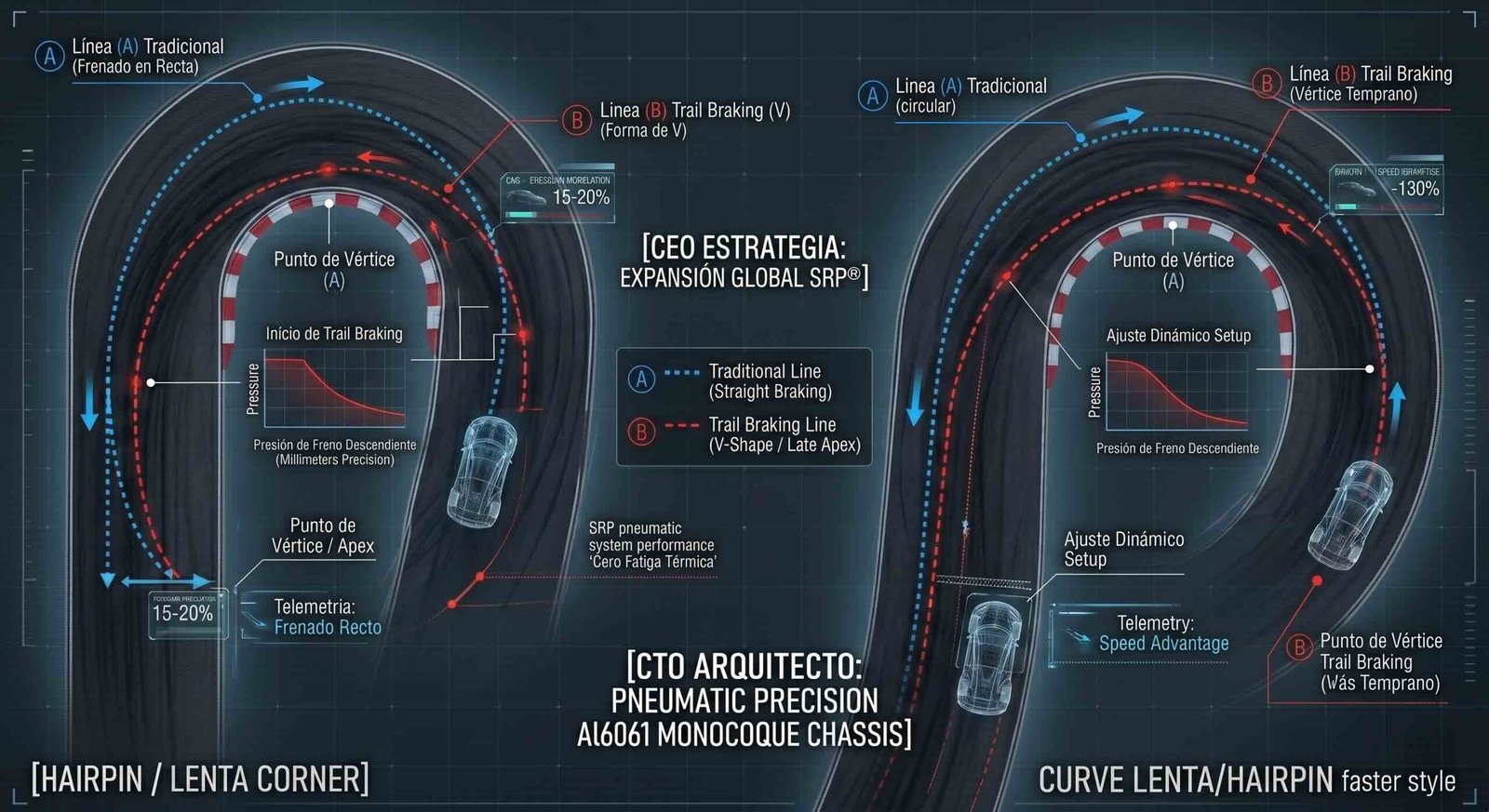
/// What Exactly is Trail Braking?
Breaking the Traditional Novice Rules
The traditional method dictates that you must brake in a straight line, release the brake completely, and then turn the steering wheel. Trail Braking breaks this rule completely.
It consists of maintaining a gradual, decreasing pressure on the brake pedal after you have started to turn the steering wheel toward the apex of the corner. Instead of a sharp cut in your telemetry (from 100% to 0%), you will see a smooth, downward ramp that overlaps with the increase in the steering angle.
/// The Physics Behind the Wheel: Why it Works
The Mechanics of Kinetic Energy Management
To understand why Trail Braking is the absolute standard in motorsport and sim racing, we must talk about the physics of weight transfer:
- Maximum Directional Grip: When you brake hard in a straight line, the car's weight transfers to the front axle. This compresses the front suspension and pushes the front tires into the tarmac, giving them maximum traction capacity.
- Avoiding the "Rebound" Effect: If you release the brake suddenly right before turning, the front suspension decompresses quickly, shifting the weight backward. If you turn at that exact moment, the front of the car will be "light," causing massive understeer.
- The Traction Circle: A tire only has 100% of available adherence. If you use 100% to brake, you cannot turn. Trail braking is the art of trading percentages: as you release the brake (from 80% to 50%, down to 20%), you use that remaining grip to apply steering angle.
/// How to Execute Trail Braking Step by Step
Surgical Execution on Every Corner Complex
If you look at the telemetry of a professional driver, flawless execution is divided into three distinct phases:
- Phase 1: Pure Deceleration (Straight Line): You apply maximum braking pressure (Threshold braking) while the car is straight to shed most of your speed.
- Phase 2: The Turn-in (Point of Rotation): Just as you move the steering wheel, you begin to gradually release the brake pressure. You are controlling the pitch of the car, keeping the nose down so the front wheels "bite" the asphalt and the car rotates on its front axle.
- Phase 3: The Apex: As you approach the inside of the corner and reach maximum steering angle, the brake pressure reaches zero. The car has already rotated and is perfectly positioned for you to get back on the throttle.
💡 Dynamic Setup Tip: The brake is your best tool for correcting the car mid-corner. If the car won't turn (understeer), hold a bit more brake pressure to keep the weight forward. If the rear wants to step out (oversteer), release the brake slightly to shift the weight back and stabilize the car.
/// When to Use It and When to Avoid It
Track Topography and Vehicle Dynamics
- Slow Corners and Hairpins (Ideal): It is vital in low-speed corners (like the Sebring hairpin or Turn 3 at the Red Bull Ring). You need the car to rotate aggressively in a short space, and Trail Braking forces that dynamic "V-shape" driving line.
- High-Speed Corners (Danger): In fast, sweeping corners, holding the brake while turning can overload the front tires and critically destabilize the rear, causing snap oversteer. Here, it is better to brake earlier, stabilize the aerodynamics, and use the throttle to settle the chassis.
Note: This technique is critical in cars with medium to low aerodynamic downforce (GT3, GT4, Mazda MX-5, or junior open-wheelers).
LIVE PADDOCK DATABANK
/// The Hardware: Why Load Cells Aren't Enough
The SRP® Pneumatic Paradigm Shift
It is nearly impossible to master the subtle trailing phase of braking with basic potentiometer pedals. And while many drivers upgrade to standard Load Cell setups, human muscle memory requires a much more refined, true-to-life pressure response to flawlessly modulate that crucial final 15-20% of brake force as you approach the apex.
To reach the absolute pinnacle of sim racing telemetry, you need the uncompromising precision of high-end pneumatic technology. Traditional hardware suffers from 'Fading'—the loss of braking efficiency due to elastomer softening under intense use. During long endurance stints, this thermal degradation turns your precise pedal into an unpredictable interface.
At SRP, our SRP GT-R Sim Racing Pedals are engineered from a solid Al6061-T6 aluminum monocoque chassis and utilize our proprietary pneumatic system. Delivering zero thermal fade and an exact 1:1 replication of a real GT race car's hydraulic brake feel, SRP provides the linear precision required to conquer every split and lower your lap times permanently.
/// TECHNICAL ARSENAL
Deploy the ultimate pneumatic advantage. Select your chassis.

SRP® GT-R
The Endurance Master. Built to survive 24h stints with zero thermal degradation. The ultimate cure for fading.
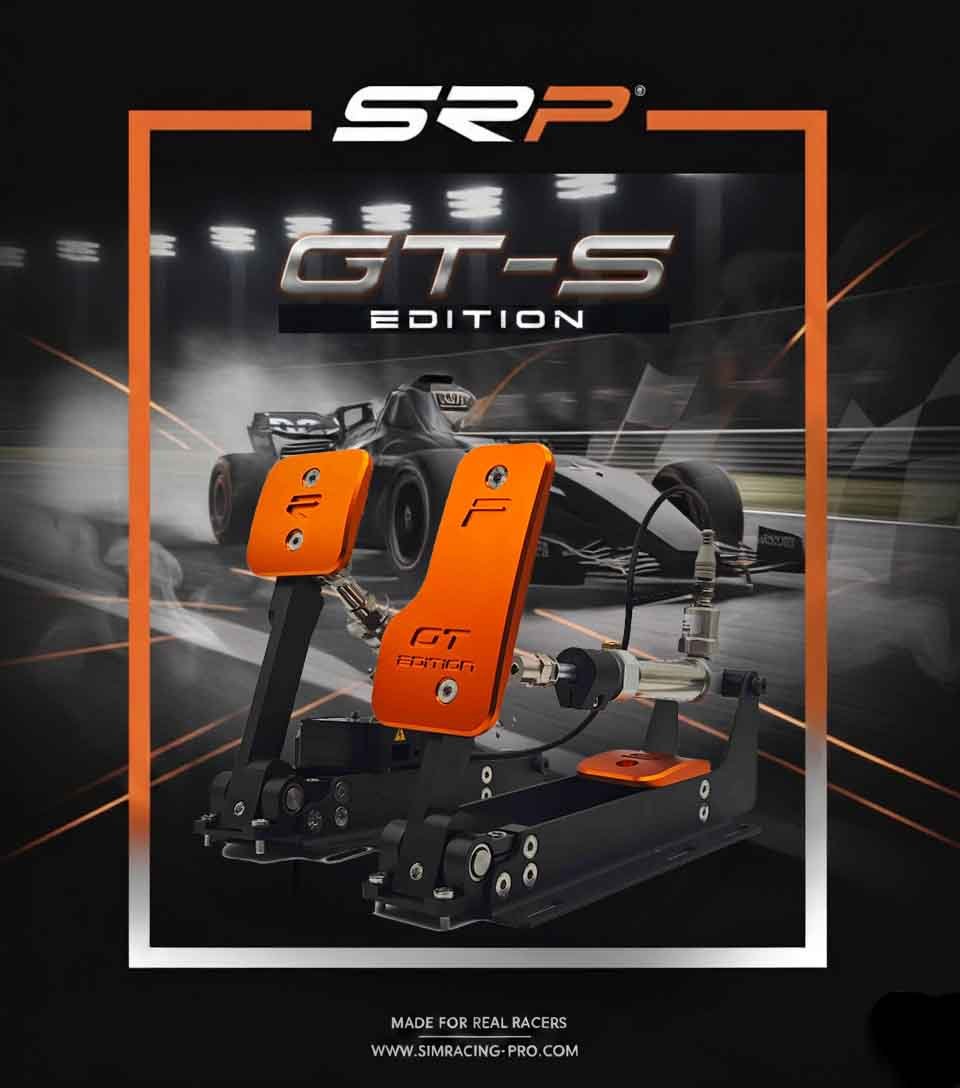
SRP® GT-S
Surgical precision for GT3 and Rally. Master the Apex with pure pneumatic linearity and feedback.
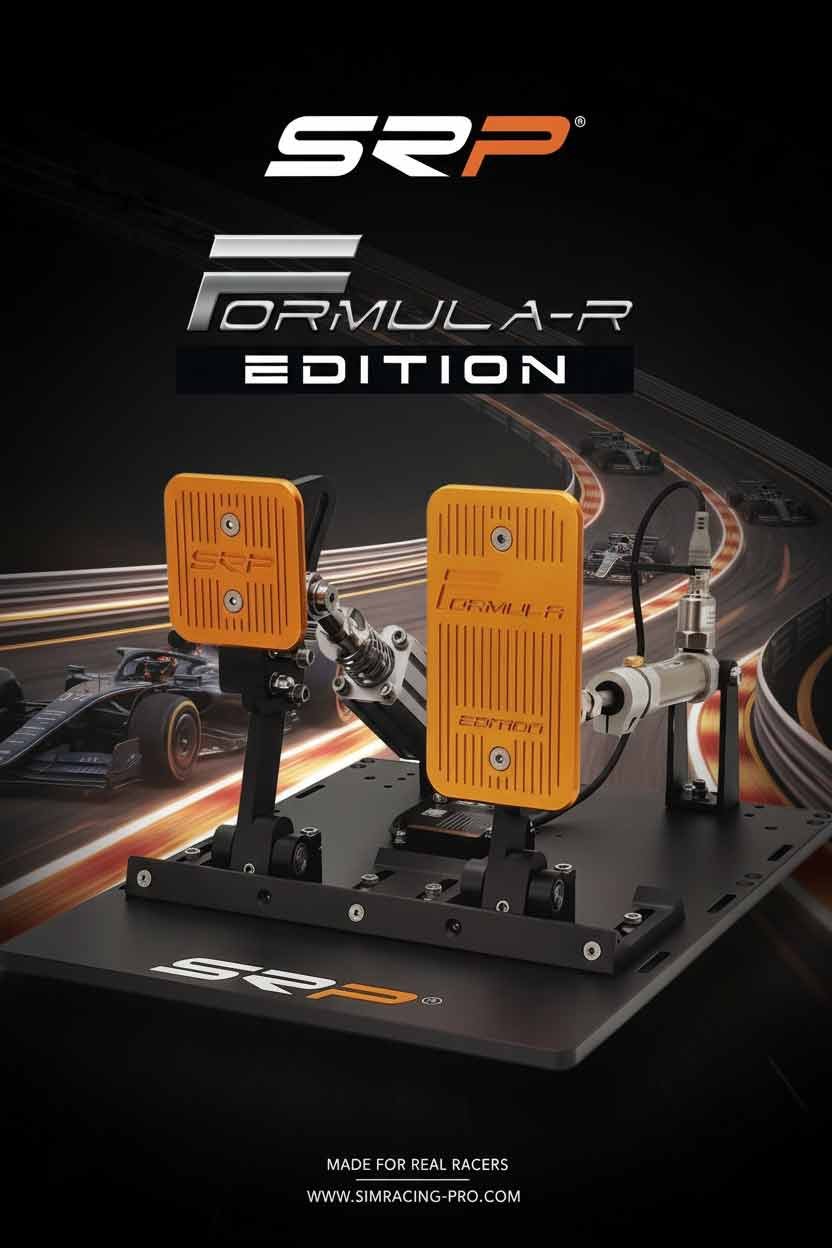
SRP® Formula-R
Ultimate Monocoque Rigidity. Built for extreme high-downforce braking maneuvers without mechanical flex.