
Stiff vs Soft Sim Racing Pedals: The Muscle Memory Guide
[EXECUTIVE BRIEFING] Every sim racer eventually faces the exact same dilemma: “Should my brake pedal be stiff like a solid brick, or soft with plenty of travel?” It’s a debate that fills forums and paddocks alike, but the answer isn’t just about personal preference. It comes down to pure biomechanics, physics, and lap consistency.
To understand pedal stiffness, you first need to understand how the human brain works. The human body is terrible at memorizing physical distances without visual cues. If someone asks you to move your foot exactly 3.4 centimeters in the dark, you will struggle to reproduce that exact movement twice. However, the human brain is exceptionally brilliant at memorizing pressure. This biological fact is why load cell and pressure-based pedals exist: muscle memory relies on force, not distance.
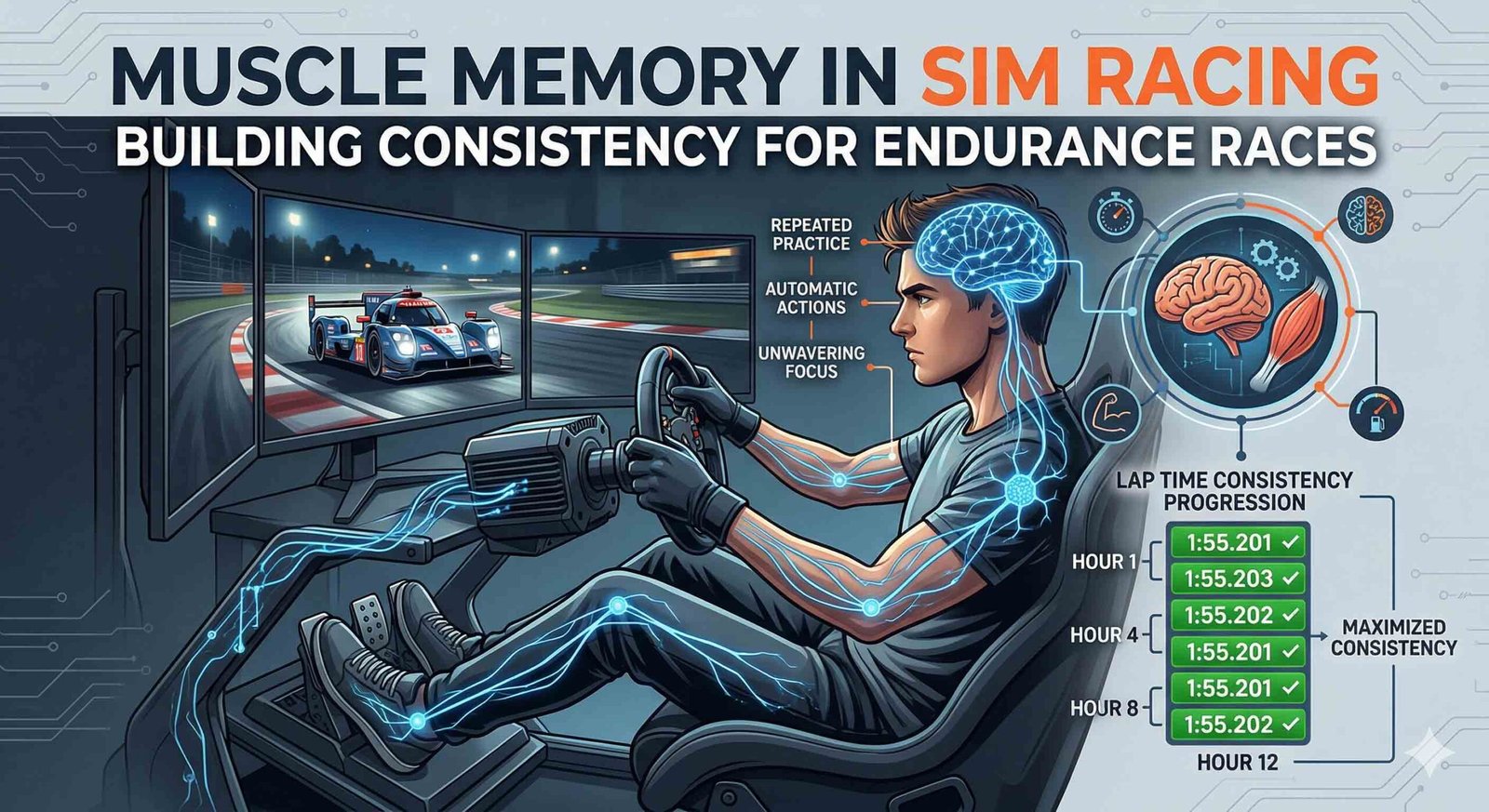
/// FIG 1.0: COCKPIT ERGONOMICS & KINETIC MEMORY
/// Distance vs. Pressure
The Biomechanical Flaw of Soft Pedals
Soft pedals—usually relying on entry-level potentiometers or very soft springs—measure the distance your foot travels. While this feels fine for driving a street car to the grocery store, it is a disaster for GT3 or Formula racing.
In competitive sim racing, you need to reach 100% maximum braking force instantly at the end of a long straight. A soft pedal creates a physical delay: your foot has to travel several inches before maxing out. More importantly, when you try to release the brake slowly into the apex (trail braking), your brain cannot rely on pressure; it has to guess the pedal’s physical position. The result? You miss apexes and lack lap-to-lap consistency.
💡 The Telemetry Factor
A soft pedal inevitably creates jagged release traces in your telemetry software. Without a solid pressure wall to push against, smoothly reducing braking force becomes a guessing game for your central nervous system.
/// The Zero-Travel Trap
Why “Brick” Load Cells Destroy Tactile Feedback
So, if soft is bad, stiffer must be better, right? Yes, up to a point. Many sim racers upgrade to high-end load cells and set them as hard as a brick wall with zero travel. But here is the trap: if a pedal has absolutely zero initial travel, you lose all tactile feedback.
Trail braking becomes a pure isometric exercise. You end up locking your tires constantly because you cannot “feel” the micro-release point of the brake pad disengaging from the rotor.
To solve this “brick” problem, traditional Load Cell pedals use rubber elastomers to provide a bit of travel before the stiff wall. The issue? Polyurethane rubber degrades with heat. During a 2-hour stint, the friction heat will make the rubber softer. Your 80kg braking point on Lap 1 might shift to 72kg by Lap 40. Your muscle memory is betrayed by the material.
/// Achieving the Perfect Curve
The Pneumatic Advantage of Atmospheric Air
How do you achieve the perfect initial travel for trail braking, while hitting a solid wall for muscle memory, all without the thermal degradation of rubber elastomers? The answer is Compressed Air.
In a real GT3 car, the brake pedal feels slightly soft as the pads make initial contact with the rotors, and then becomes exponentially stiffer as hydraulic pressure builds up. Industrial-grade pneumatic systems, like the SRP® R-Piston v5, use air chambers to replicate this exact mathematical curve.
Because air does not degrade with heat like rubber does, the pressure required to brake remains mathematically identical from the first lap to the last lap of a 24-hour endurance race. You get the perfect initial travel for precise trail braking, and an immovable force wall for perfect muscle memory. When you miss an apex with an SRP® pedal, you know it was your technique—not your hardware getting soft.
Recommended Arsenal for Perfect Braking
Ditch the elastomers. Experience the zero-fade consistency of pneumatic braking.

SRP® GT-R
The Endurance Protocol. Engineered to survive 24h stints with zero thermal degradation. The ultimate cure for inconsistent braking.
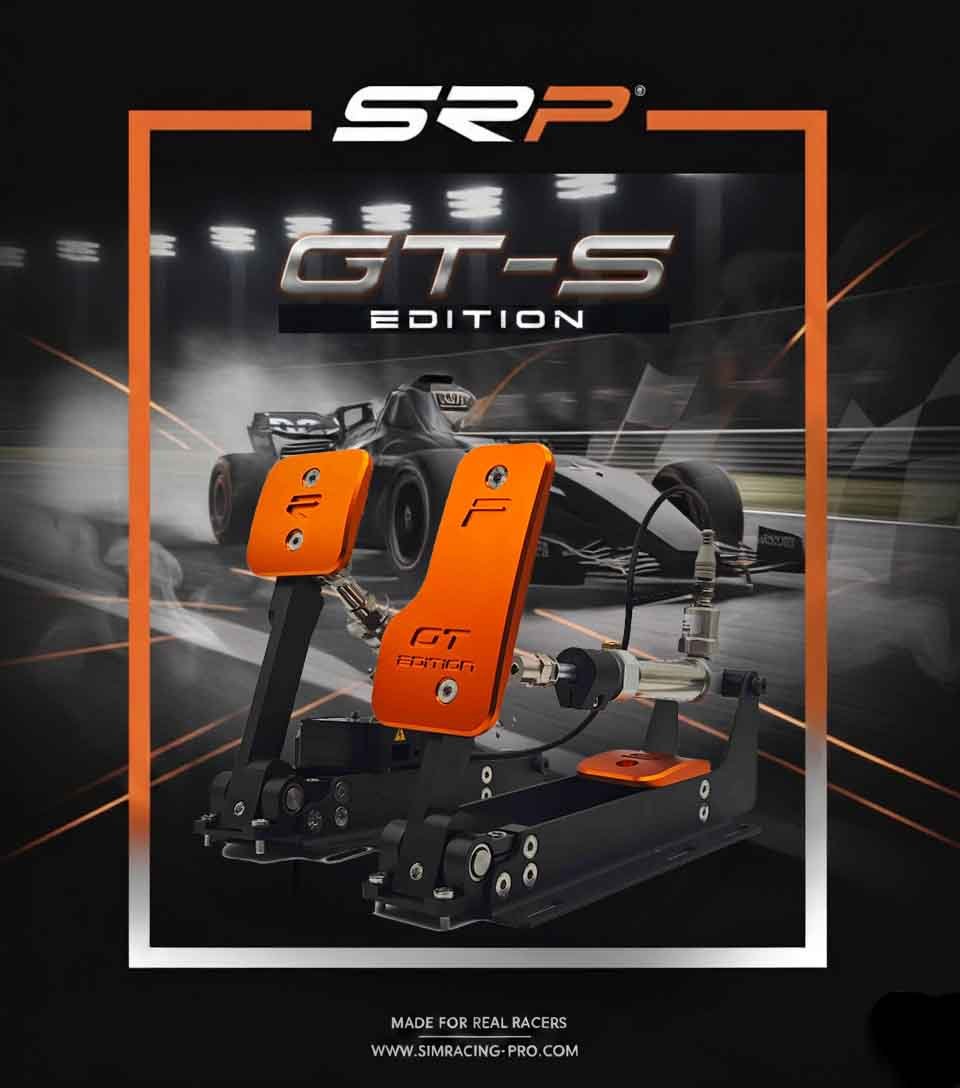
SRP® GT-S
GT3 & Rally Precision. Master every apex with pneumatic linearity and high-speed response. Say goodbye to elastomer fade.
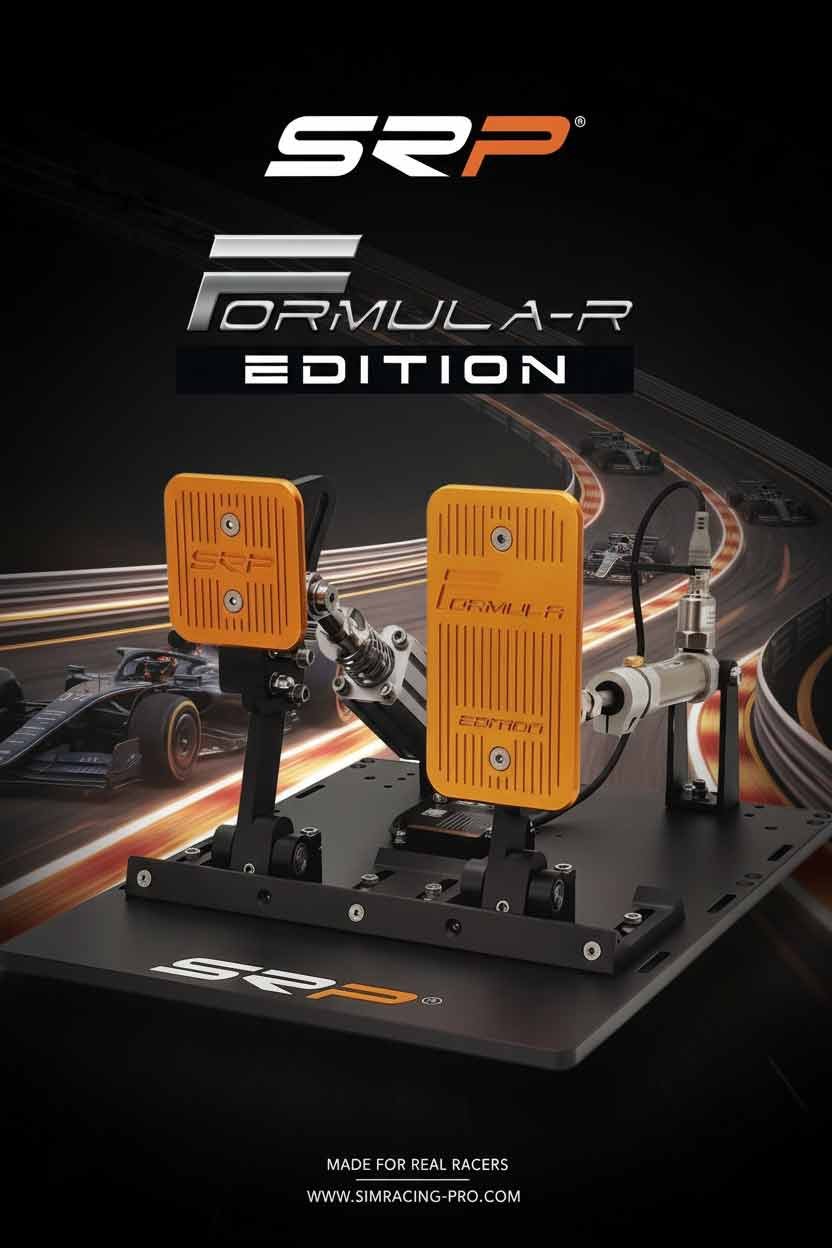
SRP® Formula-R
Ultimate Monocoque Rigidity. The Formula-R eliminates pedal plate flex for extreme high-downforce braking maneuvers.