
When building a high-end simulator, the pursuit of absolute realism often leads drivers to consider hydraulic pedals. The logic is sound: real GT3 and Formula cars use hydraulic brake systems, so replicating that in your living room or eSports facility should provide the ultimate experience.
While the physical sensation of hydraulic displacement is incredibly realistic, there is a crucial factor that is often omitted in reviews and buyer's guides: hydraulic sim racing pedals maintenance. Let's take an honest, engineering-focused look at the reality of running a liquid-based fluid system in a home simulator, and why modern high-end rigs are moving towards a cleaner, maintenance-free alternative.
The Reality of Liquid Hydraulics
A true hydraulic sim racing pedal uses a master cylinder filled with fluid (often mineral oil or automotive DOT brake fluid). When you press the pedal, a piston compresses the fluid. Because liquids are largely incompressible, this generates a highly authentic, steep resistance curve.
However, putting real automotive components in a stationary simulator introduces several mechanical vulnerabilities that real race mechanics deal with daily, but sim racers shouldn't have to.
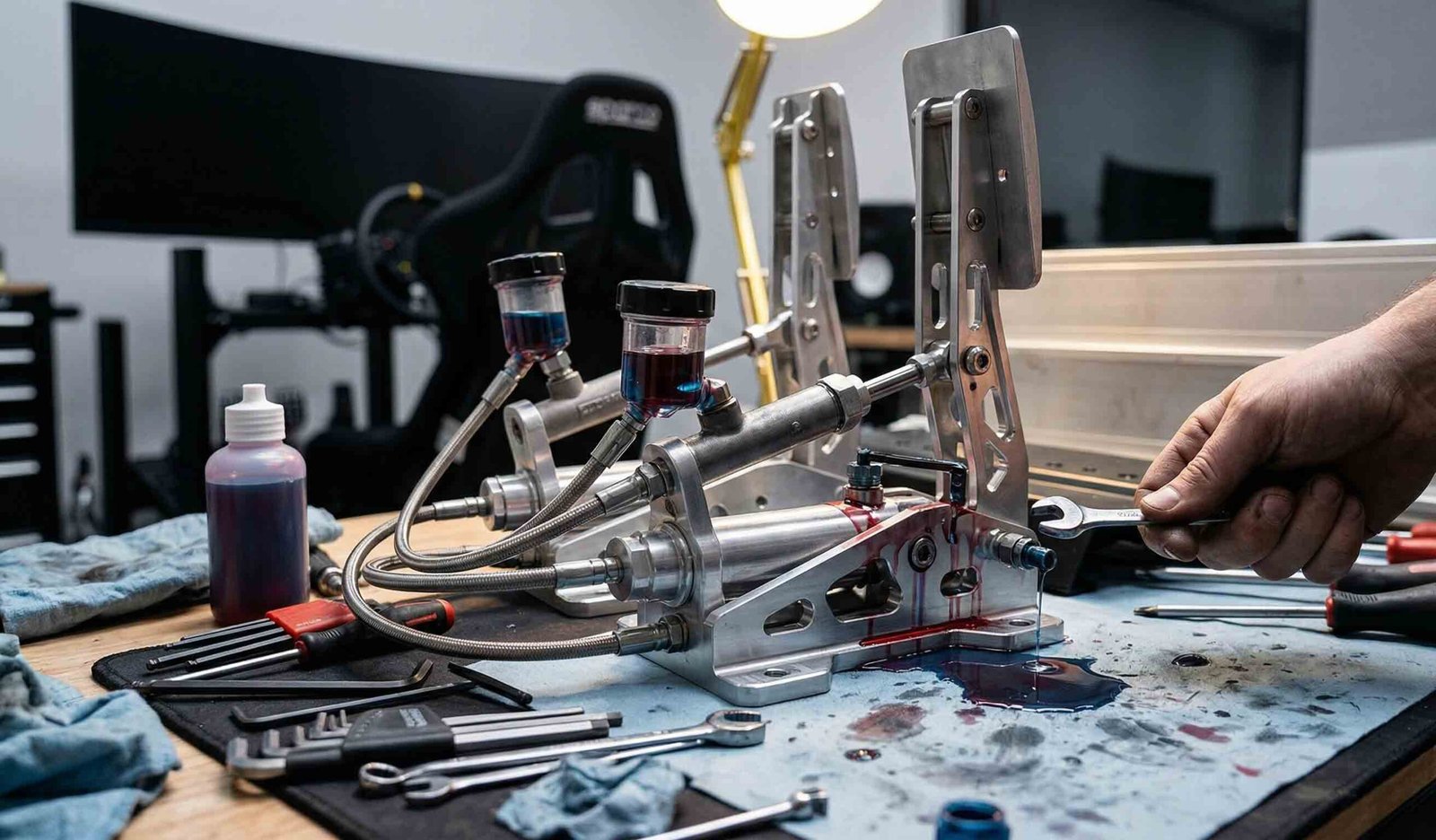
1. The Inevitability of Bleeding
Over time, microscopic air bubbles inevitably enter liquid hydraulic systems. This happens through the seals as the piston cycles back and forth thousands of times during a race. When air gets into the fluid, the brake pedal begins to feel "spongy" and inconsistent.
To fix this, you must bleed the system. This is a messy, time-consuming maintenance task that requires opening the reservoir, pushing fluid through the lines, and capturing the old oil. If you just want to sit down and drive after a long day at work, discovering a spongy brake pedal is incredibly frustrating.
2. Dust, Seals, and Micro-Leaks
Race cars operate in controlled environments and are rebuilt frequently. A sim rig sits in a room where dust, pet hair, and carpet fibers constantly float in the air. As the piston rod extends and retracts, it can pull microscopic debris past the rubber seals.
Fluid Dynamics: The Pneumatic Alternative
If elastomers (rubber) suffer from thermal fade, and liquid hydraulics require messy maintenance, what is the ultimate solution? The answer lies in physics: both liquids and gases are considered fluids.
By engineering a completely sealed, high-pressure air cylinder, you can replicate the exact mathematical resistance curve of a hydraulic system without using a single drop of liquid. This is the foundation of Pneumatic Sim Racing Pedals.
The SRP® R-Piston V5 Advantage
At SimRacing Pro, we recognized that professional drivers want the organic feel of a fluid system without the nightmare of hydraulic sim racing pedals maintenance. Our patented R-Piston V5 uses compressed air housed within an aerospace-grade AI6061 aluminum cylinder.
- Zero Fluid = Zero Leaks: There is no oil to leak onto your floor.
- Zero Bleeding Required: The closed pneumatic system never introduces "spongy" air bubbles into a liquid line because it operates entirely on air dynamics.
- Industrial Durability: Equipped with heavy-duty NBR seals, the R-Piston is certified for over 3.5 million kilometers of maintenance-free racing.
You get the exponential, authentic bite of a real GT3 master cylinder, combined with the "plug and play" reliability of a solid-state electronic device.
Frequently Asked Questions
Do pneumatic pedals feel exactly like hydraulic pedals?
Yes. Both operate on the principles of fluid dynamics. Because the SRP pneumatic cylinder is tightly sealed and uses highly pressurized air, the exponential ramp-up in resistance mimics a hydraulic master cylinder perfectly, providing the same authentic "wall" of pressure.
Will I ever need to add air to SRP pneumatic pedals?
No. The SRP R-Piston V5 is a closed, self-contained system. Unlike inflating a tire, the air inside is permanently trapped and sealed using industrial NBR seals designed to last for millions of cycles without needing to be refilled or serviced.
Why do some brands still use hydraulics?
Hydraulics use readily available real-world automotive parts (like master and slave cylinders), making them easier to source for manufacturing. Engineering a flawless, leak-proof pneumatic system for sim racing requires complex, custom-machined parts and proprietary patents, which is a harder route to take in manufacturing.
Experience true fluid dynamics with zero maintenance.
Equip the SRP® GT-R Pedals