
You can buy the most advanced pneumatic pedals on the planet, but if your knees are hitting your steering wheel or your lower back is screaming after 30 minutes, your lap times will suffer. In motorsport, speed is a byproduct of comfort and control.
Whether you are assembling your first aluminum profile cockpit or fine-tuning a professional simulator, mastering sim racing pedal positioning is just as critical as dialing in your Field of View (FOV). Let’s break down the geometry of speed and how the right hardware accessories can transform your driving experience.
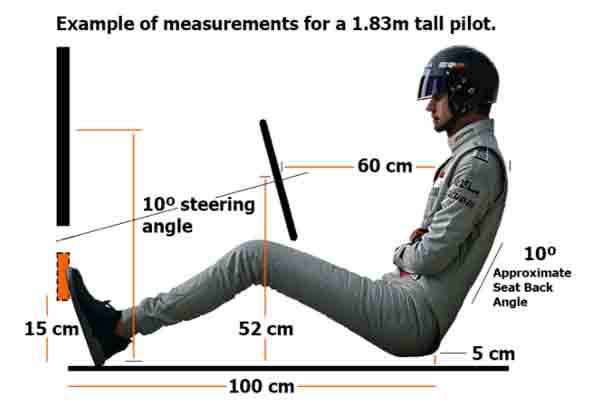
The Geometry of Speed: Seat to Pedal Distance
The most common mistake sim racers make is sitting too close to the pedals. If your leg is bent at a sharp 90-degree angle, you cannot apply maximum braking force without pushing your body backward into the seat. Conversely, if your leg locks completely straight when braking, you risk knee injury and lose modulation control.
GT vs. Formula: Tuning Your Heel Rest
The angle of your pedals must match your seating position. A Formula seating position (where your feet are elevated almost to chest level) requires a completely different pedal face angle than a GT position (where you sit upright).
To solve this, your heel must be anchored perfectly. A floating heel leads to inconsistent throttle application and sloppy trail braking. That is why we developed the SRP® Adjustable Heel Rest, machined from AI6061 aluminum with 5-axis CNC precision.
- Two Inclinations: Set it to 70° for GT racing or 90° for Formula configurations.
- Distance & Height Adjustment: Fine-tune the gap to match your foot size and shoe type.
- Maximum Stability: Reduces unnecessary foot movement, directly improving your brake modulation and throttle precision.
The Inverted Layout: Rally, Drift, and Street
If you primarily drive classic rally cars, drift, or simulate road cars, a standard floor-mounted pedal box might feel unnatural. In these vehicles, the pedals pivot from above. Inverting your pedals changes the pivot point and the arc your foot follows, which dramatically reduces strain on your knees and ankles during long, pedal-heavy sessions like heel-and-toe downshifting.
To achieve this, the SRP® Inverted Pedals Kit allows up to 11 different mounting configurations, replicating a true street or rally layout.

The Foundation: Why Baseplates Matter
Perfect sim racing pedal positioning means nothing if your rig flexes. When you apply 80kg of pressure to an SRP pneumatic brake, any flex in your aluminum profile translates to lost energy and inconsistent telemetry.
Using a dedicated SRP® Baseplate ensures that your GT-R or GT-S pedals are anchored as a single, unified block. This distributes the kinetic energy across the rig, eliminating microscopic flex and ensuring that 100% of your physical effort is registered by the simulator.
Dial In Your Setup
Ergonomics is not a one-size-fits-all metric. It requires testing, adjusting, and having the right hardware that allows for micro-adjustments. When your body is relaxed, your mind can focus entirely on hitting the apex.
Complete your cockpit with professional-grade ergonomics.
Explore SRP® Accessories