
Load Cell vs. Pneumatic Pedals in 2026
Why Rubber Elastomers Are Officially Obsolete
If you are reading buying guides for high-end sim racing gear in 2026, you will see the term "Load Cell" everywhere. For the last decade, load cell technology was the gold standard for anyone upgrading from a basic Logitech or Thrustmaster setup. But the industry has evolved, and professional drivers are demanding more.
When we debate load cell vs pneumatic pedals in 2026, we are no longer just comparing sensors; we are comparing the physical resistance mediums. It is time to expose the fatal flaw of the modern load cell pedal: the rubber elastomer.
The Load Cell Illusion
Let's clarify a misconception: a load cell is just an electronic sensor. It measures pressure (force) very accurately. The problem with 90% of the high-end pedals on the market isn't the sensor itself; it's what they use to generate that physical resistance against your foot.
To simulate the stiffness of a real race car's brake, most manufacturers stack rubber or polyurethane bushings (elastomers) behind the pedal face. You press the pedal, the rubber squishes, and the load cell measures how hard you are squishing it. It works great... for the first 10 minutes.
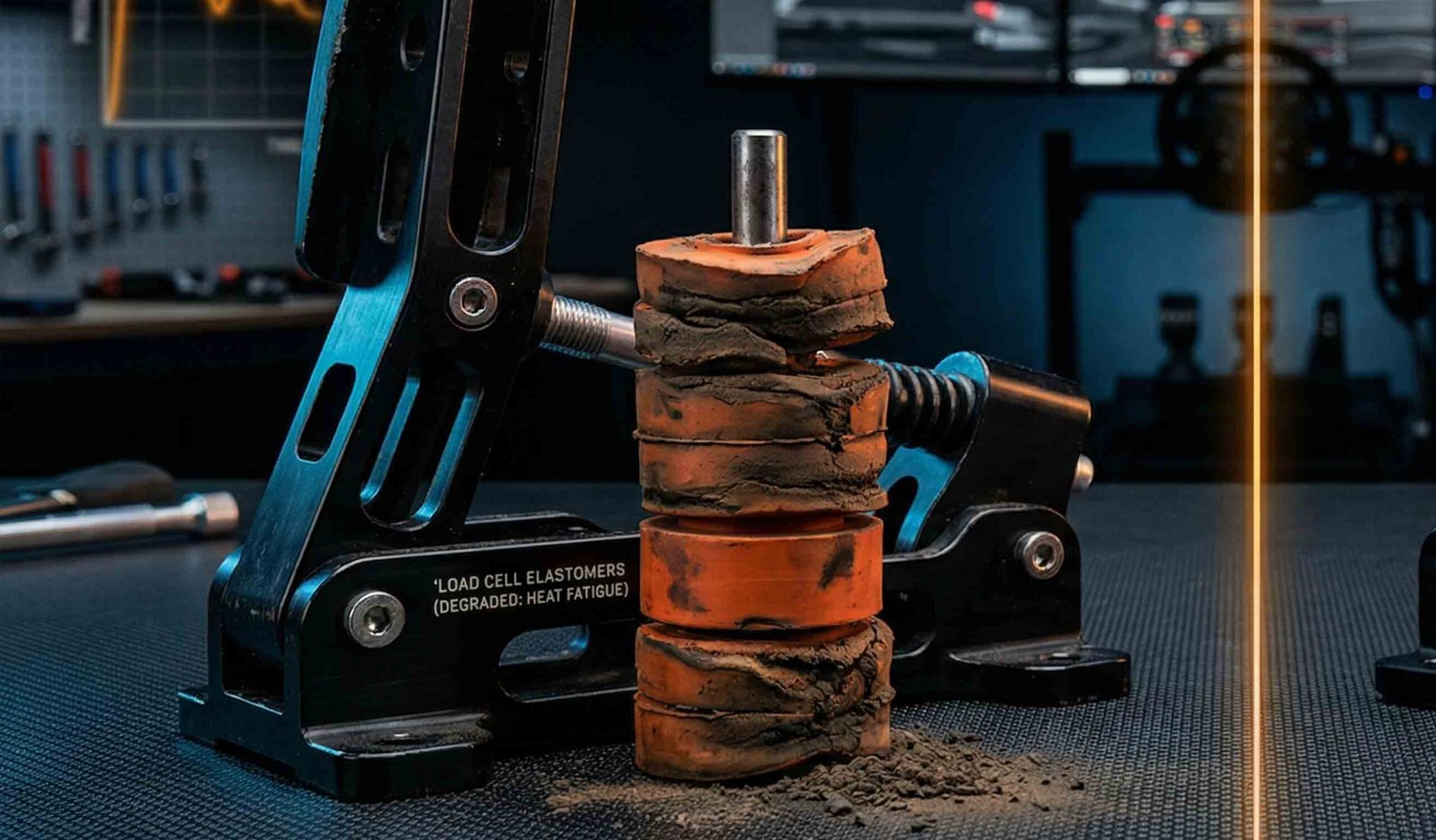
The Enemy of Pace: Thermal Fade
Motorsport is about absolute consistency. Your brain needs the brake pedal to feel physically identical on lap 1 and lap 60 to build proper muscle memory. Rubber elastomers make this mathematically impossible.
This creates a phenomenon called Thermal Fade. Applying 80kg of force at the start of a race might require 20mm of pedal travel. An hour later, as the elastomers soften, that same 80kg of force might require 25mm of travel. Your foot pushes further than your brain expects, leading to missed apexes, locked tires, and ruined trail braking.
The 2026 Standard: Pneumatic Air Dynamics
Why spend premium money on hardware that literally degrades while you use it? This question led the engineering team at SimRacing Pro to completely abandon elastomers.
Instead of crushing pieces of rubber, the SRP® R-Piston V5 compresses air inside a sealed, aerospace-grade aluminum cylinder. The physics of compressed air do not suffer from thermal fade in a sim racing environment. The exponential resistance curve you feel is pure, mechanical, and 100% consistent.
When evaluating load cell vs pneumatic pedals in 2026, pneumatic technology offers a "Zero Degradation" guarantee. The pedal travel and stiffness you dial in on day one will remain identical years later.
The "Buy Once, Cry Once" Philosophy
Many sim racers buy a mid-range load cell set, only to spend hundreds of euros over the next few years buying "upgrade kits," stiffer springs, and replacement elastomers trying to fix the inconsistent feel.
Upgrading directly to a pneumatic system like the SRP® GT-S or GT-R is an investment in industrial-grade reliability. With components certified for over 3.5 million kilometers of use, you eliminate the maintenance cycle and focus entirely on dropping your lap times.
Frequently Asked Questions
Do SRP pedals still use a sensor to measure force?
Yes. We use a highly advanced 16-bit pressure transducer (65,536 steps of resolution) that measures the pressure of the compressed air directly. It is much more accurate and has zero latency compared to traditional load cell sensors reading through crushed rubber.
Can I adjust the stiffness of a pneumatic pedal?
Absolutely. While you don't swap out pieces of rubber, the SRP ecosystem allows you to mechanically adjust the stroke (travel) of the pedal between 15mm and 45mm, letting you tune the feel from a stiff Formula car to a softer GT or Rally setup.
Will I ever need to replace parts on my SRP pedals?
Unlike load cell pedals that require frequent elastomer replacements, the SRP R-Piston V5 uses industrial NBR seals designed to last for millions of cycles. It is a zero-maintenance system.
Stop racing on rubber. Upgrade to zero thermal fade.
Discover the SRP® GT-S Pedals