
Every sim racer’s journey usually starts the same way: a desk-mounted Logitech or Thrustmaster wheel, a plastic pedal set, and an undeniable passion for motorsport. But as you pour hundreds of hours into iRacing or ACC, a harsh realization hits you. A better steering wheel won't shave seconds off your lap time. Your pedals will.
If you are standing at the crossroads, wondering if the leap to high-end sim racing pedals is worth the investment, you are not alone. Let’s break down exactly what happens when you swap plastic potentiometers for industrial-grade pneumatic physics, and why this is the last upgrade your rig will ever need.
The Problem with Entry-Level Pedals
Entry-level pedals measure distance using a potentiometer (a sensor that detects how far the pedal has moved). Real race cars, however, brake based on pressure (how hard you push the fluid into the master cylinder).
Trying to build muscle memory based on how far your foot travels in the air is nearly impossible. You end up constantly locking your tires or missing apexes because you cannot consistently replicate the exact physical position of a soft, spring-loaded pedal.
The Paradigm Shift: Braking by Pressure
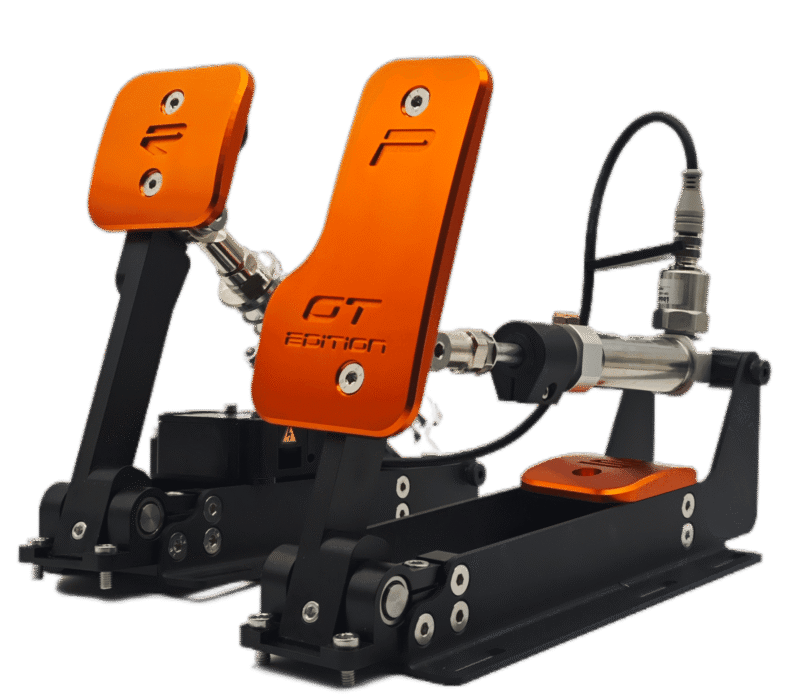
When you transition to high-end sim racing pedals, the entire physics model changes. The most common first step is a load cell, which measures force rather than distance. However, at SimRacing Pro, we bypass the limitations of load cell elastomers entirely with our Pneumatic R-Piston V5.
It will take a few days to recalibrate your brain. But once your muscle memory adapts to measuring force instead of travel, something magical happens: your lap times drop, your trail braking becomes surgical, and your consistency skyrockets.
The Price Objection: Expense vs. Investment
It is the elephant in the room: high-end pedals are a significant financial commitment. But let's look at the true cost of sim racing hardware.
Entry-level and mid-tier pedals rely on cheap springs, plastic gears, and rubber elastomers that degrade, crack, and lose their stiffness over time due to thermal fade and friction. You might end up replacing them or constantly buying upgrade kits every two years.
SRP® pedals are not built like consumer electronics; they are built like industrial machinery. Our pneumatic systems use aerospace-grade AI6061 aluminum, 5-axis CNC machining, and industrial NBR seals.
The result? The SRP® pneumatic system is certified for 3.5 million kilometers of use.
When you upgrade to SRP®, you are not buying a pedal set for the next season; you are buying the final pedal set of your sim racing career. Zero maintenance, zero thermal fade, and zero degradation. Over a five-year span, high-end pneumatic pedals are actually more cost-effective than repeatedly replacing inferior gear.
The Verdict
Upgrading to high-end sim racing pedals is the single most impactful change you can make to your simulator. You will transition from playing a video game to operating a precision motorsport tool.
If you are ready to stop guessing your braking points and start trusting your hardware, it is time to leave the toys behind.
Make the final upgrade. Experience industrial-grade pneumatic precision.
Discover the SRP® GT-S