
Step into the paddock of any professional motorsport event—from GT3 to Formula racing—and look closely at the pedal box. You will not find a single coil spring or rubber elastomer generating braking resistance. Real race cars rely on the incompressible nature of fluids.
Yet, for over a decade, the sim racing industry has sold the illusion that metal springs and rubber bushings can accurately replicate the feel of a race car. If you want to drop your lap times and build authentic muscle memory, you need to understand sim racing brake physics and why the mechanics of your hardware are holding you back.
The Anatomy of a Real Brake System
In a real motorsport vehicle, pressing the brake pedal pushes a pushrod into a master cylinder filled with hydraulic fluid. Because fluids cannot be compressed, the pedal travel is minimal. The resistance you feel is the direct result of the brake pads clamping down on the steel or carbon-ceramic rotors.
When sim racers use standard pedals, they are fighting against linear coil springs or temperature-sensitive elastomers. Springs offer linear resistance (which feels like a street car's clutch, not a brake), and rubber elastomers degrade, soften, and change their compression rate as they heat up during a race. This destroys the fundamental physics of racing: predictability.
Hydraulic vs Pneumatic Sim Racing: The Ultimate Battle
To solve the "spring problem," high-end simulator engineers turned to fluid dynamics. This brings us to the ultimate hardware debate: hydraulic vs pneumatic sim racing pedals.
Hydraulic pedals use real brake fluid, slave cylinders, and sometimes real brake calipers to replicate the exact feel of a car. The physics are identical to reality. However, they come with a heavy cost: maintenance. Hydraulic fluid can leak, seals can degrade, and the systems require bleeding, just like a real race car. For a simulator sitting in your living room or eSports facility, a fluid leak is a disaster.
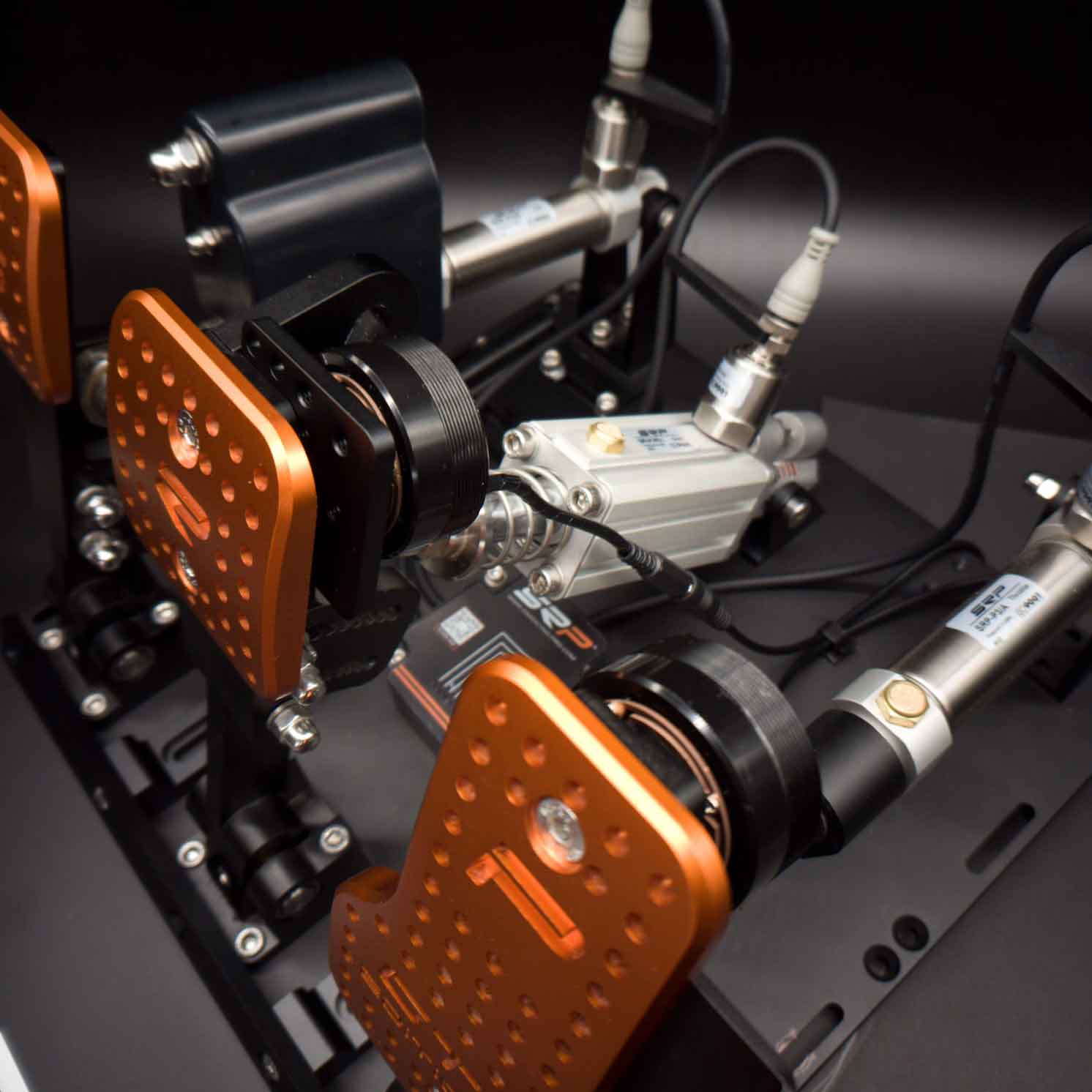
Pneumatic pedals, on the other hand, use compressed air. According to the laws of fluid dynamics, air under high pressure inside a sealed, CNC-machined cylinder behaves identically to hydraulic fluid when measuring force, but with one massive advantage: zero maintenance and zero leaks.
How the SRP® R-Piston V5 Replicates Reality
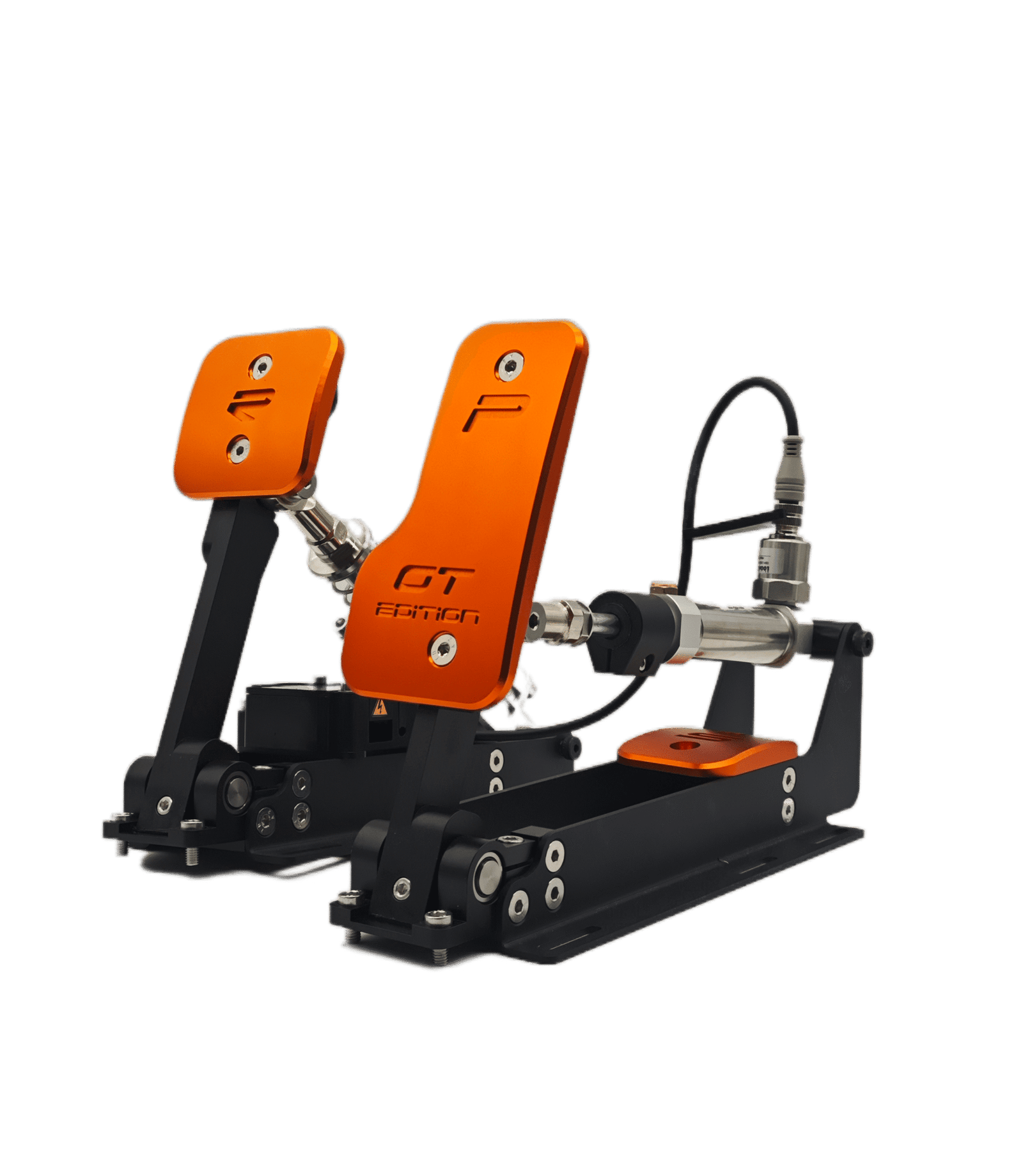
At SimRacing Pro, we refused to compromise. We wanted the exact physics of a GT3 hydraulic master cylinder without the messy maintenance. Our engineering team developed the patented R-Piston V5, a closed pneumatic system that sets the benchmark for sim racing brake physics.
Instead of crushing a piece of rubber, your foot is compressing a highly pressurized chamber of air. As the pressure builds, the resistance ramps up exponentially, hitting a rigid "wall" that perfectly mimics the moment brake pads bite into a rotor.
Furthermore, because the R-Piston V5 does not rely on friction-heavy elastomers, it suffers from Zero Thermal Fade. Your braking force is measured by a 16-bit pressure transducer with 65,536 steps of resolution, sending pure, unfiltered telemetry directly to your simulator.
Stop Simulating. Start Driving.
Understanding sim racing brake physics is the first step to becoming a faster, more consistent driver. The second step is upgrading your hardware to match your ambition. When you eliminate rubber and springs from your setup, you stop guessing your braking points and start relying on pure, unadulterated muscle memory.
Experience the exact physics of a real GT3 race car.
Equip the SRP® GT-R Pedals